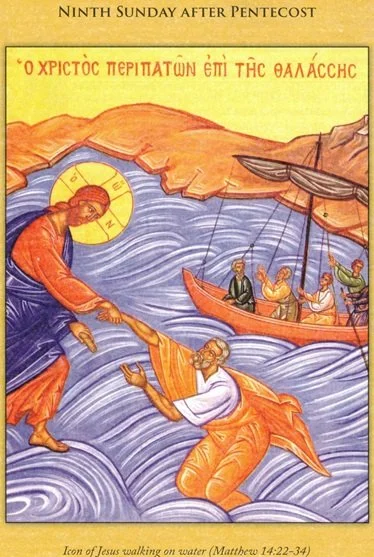
9th Sunday after Pentecost
Glory to Jesus Christ! Glory Forever!
9th Sunday After Pentecost
July 26, 2026
St. John the Baptist Byzantine Catholic
105 Kohler Ave
Lyndora PA 16045
Phone724-287-5000
www.stiohnbyzlyn.com
athanasius@zoominternet.net
Sat 7/25/26 4:00pm Vigil Divine Liturgy +Stano Protiznak by Sister Darina Protiznak
Sun 7/26/26 9:30am Divine Liturgy +Karen Bohin by Andy Bohin & Family
Fri 7/31/26 7:00pm Moleben to Mary
Sat 8/1/26 4:00pm Vigil Divine Liturgy +Prokopchak Family by Maria and Michael Streitman
Sun 8/2/26 9:30am Divine Liturgy +Peter Baycura by Drew Moniot
Variable Parts: Tone 8 - Pgs 161 — 162
Epistle: 1 Cor 3:9-17
Gospel: Mt 14:22-34
Memorial Candle Request: +Andy Baysura by Linda Baysura Mueller
Epistle Readers: 25-Jul Mary Troyan 26-Jul Mike Dancisin 1-Aug John Baycura/Mary Motko 2-Aug Kathy Moyta
Please Pray for: Lou Pocchiari, Erik Bergh, Mike Oshlick, Kathy Moyta, Dorothy Moyta, Brian Buchkovich, Lejen Warner, Sharon King, Ole J. Bergh, Liz Moyta, Fr. Michael Huszti, Fr. Laska, Susie Curcio, Teresa Milkovich, Robert Saper, Anna Habil, Mike Dancisin, Diane Sotak, Anna Pocchiari, Larry Hamil, Beverly Jones, Maryann Russin Schyvers, Nick Russin and Ken Konchan
Church Picnic/Bingo Prizes: We will, once again, have Bingo at the church picnic this year (August 2). Please consider donating prizes! The more prizes.. .the more games we can have! We will need prizes for both kids and adults. Please wrap the gifts and mark as adult or kid. Thank you so much! Questions..., see Amanda Stavish.
Honoring the Theotokos: During August and September, we honor/venerate The Blessed Mother because of the Feast Days celebrated — the Dormition and her Birth. Help us honor her by sharing your favorite icon of the Theotokos. It can be of her image or a feast day. They will be displayed in the Church windows. Stands will be provided if needed. Remember to put your name on the back so we know who it belongs to. Place your icon at any window you like. Labels are available on the readers lectern if you need one. Questions..., see Kathy Moyta.
Upcoming Event Dates:
Church Picnic - August 2nd at Connoquenessing Park.
Ladies Guild Meeting — August 9th at 11:00am in the church.
Parish Council Meeting — August 10th at 6:30pm.
Church Polka — September 12th at Highfield Hall
Quote: Yes, the kind of holiness practiced by Charbel Makhlouf is of great weight, not only for the glory of God, but for the vitality of the Church.. Pastors are needed, who gather the people of God... We need theologians...evangelizers and missionaries...catechists...people who are directly dedicated to helping their brothers… .But we also need people who offer themselves as victims for the salvation of the world, in a freely accepted penance, in an unceasing prayer of intercession… in a passionate search for the Absolute, testifying that God is worth worshiping and loving for himself. The lifestyle of these religious, of these monks, of these hermits is not offered to everyone as an imitable charisma; but in their pure state, in a radical way, they embody a spirit from which no faithful of Christ is exempt, they exercise a function which the Church cannot do without, they remind us of a salutary way for all. —Pope Paul VI, Homily for the canonization of St Sharbel
Life: Jousef Antoun Makhlouf was born in the village of Bekaa Kafra, North Lebanon. The youngest of five children, he was baptized into the Maronite Rite of the Catholic Church. The Makhlouf family lived in the highest mountain village in Lebanon and were peasant farmers. His father, who died when Jousef was only three, was a mule driver. After his father's death, his mother remarried; his stepfather later was ordained a priest where he ministered at the local parish. From a young age, Jousef lived a holy and devout life. Two of his uncles were hermits, and Jousef was inspired by their example. As a youth, he tended the cattle and often spent long periods of prayer in the wilderness while his cattle grazed. He was especially devoted to the Blessed Virgin Mary and set up a shrine to her in a nearby cave. From an early age, he knew God was calling him to the priesthood and the monastic life.
In 1851, at the age of 23, Jousef left his family, never to return, and entered the Monastery of Our Lady in Mayfouq. His mother later wrote to him saying, "If you weren't to be a good religious, I would say to you: Come back home. But I know now that the Lord wants you in His service. And in my pain at being separated from you, I say to him, resigned: May He bless you, my child." As a newly professed monk, Jousef took the name Sharbel, after Saint Charbel the Martyr, a second-century military officer who was martyred in Antioch during a persecution by the Roman Emperor Marcus Aurelius.
As a monk, Brother Sharbel longed to be a hermit and made the request to his superiors many times. For the first 24 years of his religious life, his superiors required that he live in community with the other monks. He was first transferred to the Monastery of Saint Maroun in Annaya where he professed his vows, was then sent to the Monastery of Saints Cyprian and Justina where he studied theology and philosophy, was ordained a priest in 1859 at the age of 31, and returned to the Monastery of Saint Maroun where he remained for the next 16 years. Though some monks lived as hermits, that vocation was reserved for those who proved themselves capable of such solitude and asceticism. In 1875, at the age of 47, Father Sharbel was given permission to enter the Hermitage of Saints Peter and Paul to live as a hermit after a miraculous event took place. Some of his fellow monks decided to play a prank on him, filling his oil lamp with water. When he returned to his cell, he took his water-filled lamp, lit it, and it burned. When the superiors heard about this, they inspected the lamp and found it to be filled with water. Unable to explain the miracle, the superiors saw it as a sign of his sanctity and agreed to permit him to become a hermit, according to his desire. He was sent to the Hermitage of Saints Peter and Paul where he spent the next 23 years in solitude, embracing a strict regime of daily prayer, manual work, and severe asceticism, In 1898, at the age of 70, Brother Sharbel suffered a stroke while offering Mass and died 8 days later on Christmas Eve. He was buried in the ground without a coffin, according to the custom.
Though St Sharbel lived a life of extraordinary holiness, it wasn't until after his death that his holiness became well known beyond the walls of the monasteries. After his burial, light was seen shining forth from his grave. This phenomenon drew the attention of many villagers who braved the cold and snow to see this mysterious light. After four months, permission was granted by the Church authorities to exhume his body. To the wonderment of all, his body was found to be completely incorrupt. His skin and joints were like one who was sleeping, soft and flexible. He was cleaned of the dirt and mud from his gravesite and placed in a coffin in the monastery chapel. Then something else began to happen. Blood and sweat appeared to be coming forth from his pores, soaking his habit. It was so pronounced that his clothing needed to be changed twice a week. Finally, in 1927, his body was carefully examined by two physicians from Beiurut, placed in another coffin, and sealed in a tomb inside the monastery wall.
A little more than two decades later, a blood-like liquid was seen coming from the corner of the wall behind which Sharbel was buried. In the 1950's, his tomb was opened three times. One of those times was broadcast on television and attended by high-ranking state officials, religious officials, medical doctors and scientists. In 1965 his body was found, once again, to be incorrupt and exuding the same blood and sweat. Finally, in 1976, the year before his canonization, his body was found to have finally decayed, only the bones remaining. Interestingly, the decay of Sharbel's body coincided with the early days of the devastating civil war that broke out in Lebanon in 1975. In 1976, the Damour massacre took place. Palestinians attacked the Maronite Christian town. Many of Damour's residents were killed in battle, massacred, or forced to flee. Ever since Sharbel's burial, those who have visited his grave have attributed many miracles to his intercession. This was especially the case in the 1950's when he was found incorrupt after fifty years. At that time, the monks started to keep track of miraculous cures that were attributed to Father Sharbel's intercession. Within two years, they had a list of more than twelve thousand reported cures. Devotion to him and his incorrupt body spread rapidly. The devotion, coupled with reports of numerous miracles, led to a new evangelization across Lebanon. In life, he was deeply united to God. He responded to his vocation as a hermit, living a life of daily penance, sacrifice, deep prayer, and humble service as a priest. As a result, he became one of the most influential saints of the past century. We celebrate his feast day on 24 July.
Our parish has a liquid that flows from the body of the saint; it is placed in the tabernacle on the altar.