8th Sunday after Pentecost Sunday of the Fathers of the first 6 Ecumenical Councils
Glory to Jesus Christ! Glory Forever!
7th Sunday After Pentecost
July 12, 2026
St. John the Baptist Byzantine Catholic
105 Kohler Ave
Lyndora PA 16045
Phone724-287-5000
www.stiohnbyzlyn.com
athanasius@zoominternet.net
Sat 7/18/26 4:00pm Divine Liturgy +Lansing Hills by Cindy Hills
Sun 7/19/26 9:30am Divine Liturgy +Peter and +Mary Kavchak by Drew Moniot
Fri 7/24/26 7:00pm Moleben to Mary
Sat 7/25/26 4:00pm Vigil Divine Liturgy +Stano Protiznak by Sister Darina Protiznak
Sun 7/26/26 9:30am Divine Liturgy +Karen Bohin by Andy Bohin & Family
Variable Parts: Tone 7 - Pgs 156 — 158; Fathers of the 6 Councils — Pgs 341 - 342
Epistle: 1 Cor 1:10-18 Or Heb 13:7-16
Gospel: Mt 14:14-22 Or in 17:1-13
Memorial Candle Request: +Joseph Baysura by Linda Baysura Mueller
Epistle Readers: 18-Jul John Baycura/Mary Motko 19-Jul Joel Hills 25-Jul Mary Troyan 26-Jul Mike Dancisin
Please Pray for: Lou Pocchiari, Erik Bergh, Mike Oshlick, Kathy Moyta, Dorothy Moyta, Brian Buchkovich, Lejen Warner, Sharon King, Ole J. Bergh, Liz Moyta, Fr. Michael Huszti, Fr. Laska, Susie Curcio, Teresa Milkovich, Robert Saper, Anna Habil, Mike Dancisin, Diane Sotak, Anna Pocchiari, Larry Hamil, Beverly Jones, Maryann Russin Schyvers, Nick Russin and Ken Konchan
Attendance: 7/11 — 24 7/12 — 59
Collection: $1,676.00
Church Picnic/Bingo Prizes: We will, once again, have Bingo at the church picnic this year ( August 2.) Please consider donating prizes! The more prizes...the more games we can have! We will need prizes for both kids and adults. Please wrap the gifts and mark as adult or kid. Questions.... see Amanda Stavish.
Honoring the Theotokos: During August and September, we honor/venerate The Blessed Mother because of the Feast Days celebrated — the Dormition and her Birth. Help us honor her by sharing your favorite icon of the Theotokos. It can be of her image or a feast day. They will be displayed in the Church Windows. Stands will be provided if needed. Remember to put your name on the back so we know who it belongs to. Place your icon at any window you like. Labels are available on the readers lectern if you need one. Questions....see Kathy Moyta.
Upcoming Event Dates: Church Picnic - August 2nd at Connoquenessing Park. Ladies Guild Meeting —August 9th at 11:00am in the church. Parish Council Meeting — August 10th at 6:30pm. Church Polka — September 12th at Highfield Hall
The Holy Prophet Elijah is one of the greatest of the prophets and the first dedicated to virginity in the Old Testament. He was born in Tishba of Gilead into the Levite tribe 900 years before the Incarnation of the Word of God. Saint Epiphanius of Cyprus gives the following account about the birth of the Prophet Elijah: "When Elijah was born, his father Sobach saw in a vision angels of God around him. They swaddled him with fire and fed him with flames." The name Elijah (the Lord's strength) given to the infant defined his whole life. From the years of his youth he dedicated himself to the One God, settled in the wilderness and spent his whole life in strict fasting, meditation and prayer. Called to prophetic service, which put him in conflict with the Israelite king Ahab, the prophet became a fiery zealot of true faith and piety.
During this time the Israelite nation had fallen away from the faith of their Fathers, they abandoned the One God and worshipped pagan idols, the worship of which was introduced by the impious king Jereboam. Jezebel, the wife of king Ahab, was devoted to idol worship. She persuaded her husband to build a temple to the pagan god Baal, which led many Israelites away from the worship of the true God. Beholding the ruin of his nation, the Prophet Elijah began to denounce King Ahab for impiety, and exhorted him to repent and turn to the God of Israel. The king would not listen to him. The Prophet Elijah then declared to him, that as punishment there would be neither rain nor dew upon the ground, and the drought would cease only by his prayer. Indeed, the word of Elijah was a torch (Eccles. 48: 1). The heavens were closed for three and a half years, and there was drought and famine throughout all the land.
During this time of tribulation, the Lord sent him to a cave beyond the Jordan. There he was miraculously fed by ravens. When the stream Horath dried up, the Lord sent the Prophet Elijah to Sarephta to a poor widow, a Sidonian Gentile who suffered together with her children, awaiting death by starvation. At the request of the prophet, she prepared him a bread with the last measure of flour and the remainder of the oil. Through the prayer of the Prophet Elijah, flour and oil were not depleted in the home of the widow for the duration of the famine. By the power of his prayer the prophet also performed another miracle: he raised the dead son of the widow. After the end of three years of drought the Merciful Lord sent the prophet to appear before King Ahab, and promised to send rain upon the earth. The Prophet Elijah told the king to order all of Israel to gather upon Mount Cannel, and also the priests of Baal. When the nation had gathered, the Prophet Elijah proposed that two sacrificial altars be built: one for the priests of Baal, and the other for the Prophet Elijah who served True God. The Prophet Elijah told them to call on their gods to consume the sacrificial animals with fire, and he would call on his. Whichever was first to send fire on the sacrifice would be acknowledged as the true God. The prophets of Baal called out to their idol from morning till evening, but the heavens were silent. Towards evening the holy Prophet Elijah built his sacrificial altar from twelve stones, the number of the tribes of Israel. He placed the sacrifice upon the wood, gave orders to dig a ditch around the altar and commanded that the sacrifice and the wood be soaked with water. When the ditch had filled with water, the prophet turned to God in prayer. Through the prayer of the prophet fire came down from heaven and consumed the sacrifice, the wood, and even the water. The people fell down to the ground, crying out: "Truly, the Lord is God!" Then the Prophet Elijah had all the pagan-priests of Baal put to death, and he began to pray for rain. Through his prayer the heavens opened and an abundant rain fell, soaking the parched earth.
King Ahab acknowledged his error and repented of his sins, but his wife Jezebel threatened to kill the prophet of God. The Prophet Elijah fled into the Kingdom of Judea and, grieving over his failure to eradicate idol worship, he asked God to let him die. An angel of the Lord came before him, strengthened him with food and commanded him to go upon a long journey. The Prophet Elijah traveled for forty days and nights and, having arrived at Mount Horeb, he settled in a cave.
The Lord told him that the next day Elijah would stand in His presence. There was a strong wind that crushed the rocks of the mountain, then an earthquake, and afire, but the Lord was not in them. The Lord was in "a gentle breeze" (3 Kings 19: 12). He revealed to the prophet, that He would preserve seven thousand faithful servants who had not worshipped Baal. Later, the Lord commanded Elijah to anoint Elisha into prophetic service. Because of his fiery zeal for the Glory of God the Prophet Elijah was taken up alive into Heaven in a fiery chariot. The Prophet Elisha received Elijah's mantle, and a double portion of his prophetic spirit. Elijah's Return: The last Old Testament prophetic book, Malachi, ends with these words of the Lord: "Lo, I will send the prophet Elijah before the coming of the awesome, fearful day of the Lord He shall reconcile parents with children and children with their parents so that, when I come, I do not strike the whole land with utter destruction" (Malachi 3:23-24). Believing Jews saw Elijah's return as a herald of the Messiah's coming. To this day Jews pray every Sabbath: "Elijah the prophet, Elijah the Thisbite — let him come quickly in our day with the Messiah, the son of David."
We Christians, of course, believe that the Messiah has come — it is Jesus. Jesus Himself identified John the Baptist as Elijah come again: "If you are willing to receive it, he is Elijah who is to come" (Matthew 11:14). But we Christians also believe that Elijah is "the herald of the Second Coming of Christ": the coming in power at the end of the age when Jesus will be seated on the throne and will judge the nations.
Saint of the week:
BI Pavel Gojdic a Byzantine Catholic bishop, became known to his people as 'the man with a heart of gold'. Pavel was born on 17th July 1888 near the city of Pregov, in eastern Slovakia, into the family of the Byzantine Catholic priest. He studied for the priesthood in Budapest and was ordained at Pregov in 1911. In 1922, desiring to live a humble and ascetic life, he joined the Order of Monks of St. Basil the Great at Mukacevo in south-west Ukraine, taking the religious name Pavel. But in 1926 he was ordained a bishop in the crypt of the Basilica of San Clemente in Rome, where there is a chapel to the Slav saints, Cyril and Methodius. As bishop he promoted the spiritual life of clergy and faithful, insisting on the proper celebration of the liturgy and of church feasts. During World War II and especially during the German occupation of Czechoslovakia, he strongly defended persecuted Jewish people and provided for them a hiding place and nutrition. He even helped to organize safe escape routes for Jewish people who were fleeing into Palestine. For His enormous support and protection of the Jewish people He received the title of "Righteous among the Nations" from the Government of Israel.
Communist pressure - From 1948 onwards Bishop Gojdic resisted the enormous pressure from the Communists to bring the Byzantine Catholics into the Russian Orthodox Church. He was offered the highest post (patriarch) in the newly created Orthodox church in Czechoslovakia in exchange of renouncing the Catholic faith. He refused to do it. In 1950, as a consequence of refusing to become an orthodox, he was arrested, and after a trial was sentenced to life imprisonment for treason. The Treason consisted of accusing the bishop of collaboration with the foreign state of Vatican. The government requested the death penalty but due the fact that the Communistic regime gave the bishop in the year 1948 the highest state reward for saving the tens of thousands people from the Nazis, the verdict was changed to life imprisonment. In prison he was put through physical and psychological punishments, but he used the time to pray and was able to celebrate the Eucharist in secret. He was forced to walk constantly until he’d collapsed from lack of sleep. Non stop interrogation and torture on a daily basis had an impact on his physical health. Following an amnesty in 1953, his sentence was commuted to 25 years. He was then 66 and his health was quickly deteriorating. It was proposed to release him if he would agree to become Patriarch of the Orthodox Church in Czechoslovakia. He resisted this tempting offer, saying that this would be a grave sin against God, a betrayal of the Pope, of his conscience and of his faithful. One consolation was a telegram he received from Pope Pius XII on his 70th birthday, assuring him of his prayers.
Death and posthumous honors Before Bishop Gojdic died, when he was in the prison hospital of Leopoldov. A priest, Father Alojz Vrana, was transferred into the same room with him and the bishop was able to go to confession. He was buried without ceremony in a nameless tomb in the prison cemetery, with just his prison number 681. He was beatified in 2001 by St. John Paul II. We have the relics of the saint in our church. Let us pray to him for ability to rely on our faith
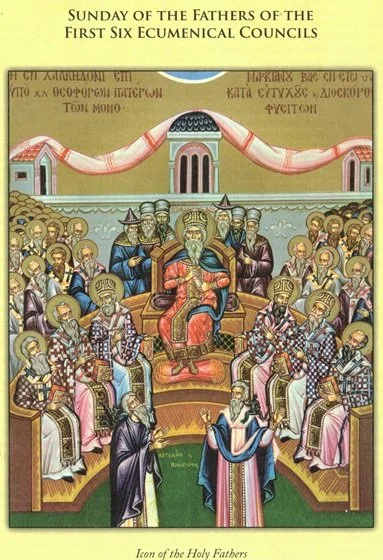
The Commemoration of the Holy Fathers of the First Six Ecumenical Councils.
In the Ninth Article of the Nicea-Constantinople Symbol of Faith proclaimed by the holy Fathers of the First and Second Ecumenical Councils, we confess our faith in "One, Holy, Catholic, and Apostolic Church."
By virtue of the catholic nature of the Church, an Ecumenical Council is the Church's supreme authority, and possesses the competence to resolve major questions of church life. An Ecumenical Council is comprised of archpastors and pastors of the Church, and representatives of all the local Churches, from every land of the "oikumene" (i.e. from all the whole inhabited world).
The First Ecumenical Council (Nicea I) was convened in the year 325 against the heresy of Arius, in the city of Nicea in Bithynia under emperor Constantine the Great.
The Second Ecumenical Council (Constantinople I) was convened in the year 381 against the heresy of Macedonias, by the emperor Theodosius the Great.
The Third Ecumenical Council (Ephesus) was convened in the year 431 against the heresy of Nestorius, in the city of Ephesus by the emperor Theodosius the Younger.
The Fourth Ecumenical Council (Chalcedon) was convened in the year 451, against the Monophysite heresy, in the city of Chalcedon under the emperor Marcian.
The Fifth Ecumenical Council (Constantinople II) "Concerning the Three Chapters," was convened in the year 553, under the emperor Justinian the Great.
The Sixth Ecumenical Council (Constantinople III) met during the years 680-681, to fight the Monothelite heresy, under the emperor Constantine Pogonatos.
The Church venerates the Holy Fathers of the Ecumenical Councils because Christ has established them as "lights upon the earth," guiding us to the true Faith. "Clad in the garment of truth," the doctrine of the Fathers, based upon the preaching of the Apostles, has established one faith for the Church. The Ecumenical Councils, are the highest authority in the Church. Such Councils, guided by the grace of the Holy Spirit, and accepted by the Church, are infallible.
The Catholic Church's conciliar definitions of dogma approved by pope have the highest authority, and such definitions always begin with the Apostolic formula: "It seemed good to the Holy Spirit and to us..." (Acts 15: 28).
The Ecumenical Councils were always convened for a specific reason: to combat false opinions and heresies, and to clarify the Catholic Church's teaching. But the Holy Spirit has thus seen fit, that the dogmas, the truths of faith, immutable in their content and scope, constantly and consequently are revealed by the conciliar mind of the Church, and are given precision by the holy Fathers within theological concepts and terms in exactly such measure as is needed by the Church itselffor its economy of salvation. The Church, in expounding its dogmas, is dealing with the concerns of a given historical moment, "not revealing everything in haste and thoughtlessly, nor indeed, ultimately hiding something" (Saint Gregory the Theologian).
A brief summary of the dogmatic theology of the First Six Ecumenical Councils is formulated and contained in the First Canon of the Council of Trullo (also known as Quinisext), held in the year 692. The 318 Holy Fathers of the First Ecumenical Council are spoken of in this Canon I of Trullo as having: "with unanimity of faith revealed and declared to us the consubstantiality of the three Persons of the Divine nature and, ... instructing the faithful to adore the Father, Son, and Holy Spirit with one worship, they cast down and dispelled the false teaching about different degrees of Divinity."