7th Sunday after Pentecost
Glory to Jesus Christ! Glory Forever!
7th Sunday After Pentecost
July 12, 2026
St. John the Baptist Byzantine Catholic
105 Kohler Ave
Lyndora PA 16045
Phone724-287-5000
www.stiohnbyzlyn.com
athanasius@zoominternet.net
Sat 7/11/26 4:00pm Divine Liturgy +Prokopchak Family by Maria and Michael Streitman
Sun 7/12/26 9:30am Divine Liturgy +Frank Dano by Children
Fri 7/17/26 7:00pm Moleben to Mary
Sat 7/18/26 4:00pm Divine Liturgy +Lansing Hills by Cindy Hills
Sun 7/19/26 9:30am Divine Liturgy +Peter and +Mary Kavchak by Drew Moniot
Variable Parts: Tone 6 - Pages 152 — 153
Epistle: Rom 15:1-7
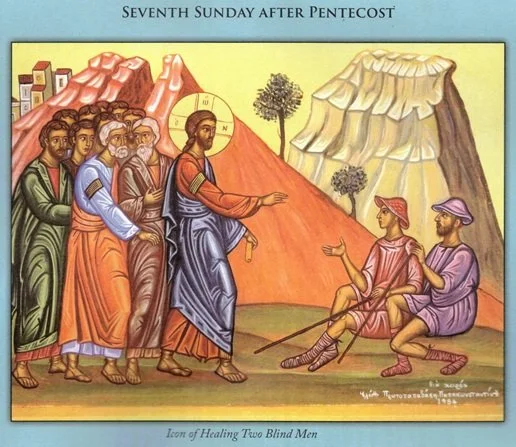
Gospel: Matthew 9:27-35
Memorial Candle Request: In memory of Andy and Pearl Baysura- by Linda Baysura Mueller
Epistle Readers: 11-Jul Mary Troyan 12-Jul Amanda Slavish 18-Jul John Baycura/Mary Motko 19-Jul Joel Hills
Please Pray for: Lou Pocchiari, Erik Bergh, Mike Oshlick, Kathy Moyta, Dorothy Moyta, Brian Buchkovich, Lejen Warner, Sharon King, Ole J. Bergh, Liz Moyta, Fr. Michael Huszti, Fr. Laska, Susie Curcio, Teresa Milkovich, Robert Saper, Anna Habil, Mike Dancisin, Diane Sotak, Anna Pocchiari, Larry Hamil, Beverly Jones, Maryann Russin Schyvers, Nick Russin and Ken Konchan
Attendance: 6/29 - 31; 7/4 - 14; 7/5 - 74
Collection: $2353
2026 Faith & Fun Day Sign-Up
The 2026 Faith & Fun Day for Archeparchial Altar Servers will be on Mondoy July - 27th. Here is the tentative schedule:
9:30am Divine Liturgy at Holy Ghost Church McKees Rocks
10:45am Depart by bus to Byzantine Catholic Seminary (presentation, tour, and lunch by Remo’s Catering
12:30pm Depart from Seminary to Museum of Illusions
2:30pm Depart from Museum to Puttshack
5:00pm Depart from Puttshack to Pirates game (after the game return to Holy Ghost Church for pick-up and head back home)
Please complete the following registration form & submit asap. The absolute deadline is Sunday. July 19. 2026. For any further information you may call my cell phone at 412-480-4508 or Fr. Frank Firko at 412-771-3324.
Link for online registration for altar servers and parents: https://forms.gle/fhP4k8whd13ovQHM9
Upcoming Event Dates:
Church Picnic - August 2nd at Connoquenessing Park.
Ladies Guild Meeting – August 7th at 11:00am in the church.
Parish Council Meeting – August 10 th at 6:30pm
Church Polka – September 12th at Highfield Hall
In 1918, E.P. Schwartz pushed his 4-year-old daughter, Jean, in a small carriage through the University of Notre Dame campus near South Bend, Indiana. Two years earlier, polio had left the little girl’s left leg paralyzed and bent so that she was unable to stand on it. When she passed children playing, she must have felt sad knowing that she couldn’t join them.
Though many doctors had told Schwartz that Jean would remain crippled, he had brought her to Notre Dame from their home in Lansing, Michigan, to seek the prayer of Congregation of Holy Cross Brother Columba O’Neill, who, along with being a shoemaker, was known for healings that resulted from his intercession to the Sacred Heart of Jesus and the Immaculate Heart of Mary. The now -Servant of God, who himself had suffered from a congenital foot disability, simply patted her on the head and said, “The little girl will be alright,” Jean Schwartz Donohue recalled in the memoir she wrote for her family. The shoemaker also recommended she visit a chiropractor to stretch the leg to the length of her other one.
On the way home, Schwartz noticed that his daughter’s leg was no longer bent, said Barbara Fulkerson, of
Michigan City, Indiana, one of Donohue’s 10 children. “Whatever he did released that leg so it hung like the other one,” she told the Register, adding that her mother only had a slight limp afterward. Fulkerson said her mother went on to complete college, have a career and raise a family.
Jean Schwartz Donohue’s cure is one of thousands attributed by the Congregation of Holy Cross to the intercession of the humble shoemaker whose devotion and patient prayer to the Sacred Heart of Jesus for the sick earned him the name “Miracle Man of Notre Dame” in the early 20th century.
Following the location of thousands of letters documenting Brother Columba’s reach and ministry, including 1,400 that refer to special favors received from his prayer, Bishop Kevin Rhoades of the Diocese of Fort Wayne-South Bend, Indiana, accepted the congregation’s petition to pursue the cause for Brother Columba’s canonization and opened the diocesan inquiry into his cause in 2022.
People could see he was such a man of prayer. He was kind to everyone. And when people would come to get their shoes fixed, he would give them Sacred Heart badges. And some people who came were sick or had various maladies, both spiritual and physical. And then a lot of cures started to be reported, a lot of favors, a lot of healings … where people testify to favors and even miracles through the Sacred Heart of Jesus.
Brother Columba was born John O’Neill in 1848 to poor but devout Irish immigrants in the coal-mining town of Mackeysburg, Pennsylvania, the same region where Bishop Rhoades was raised. The fifth of six children, he had clubfoot, a congenital foot deformity. An operation later in life helped correct the disability. Because of his feet, John couldn’t work in the mine with his family members and instead was encouraged to learn shoemaking, possibly apprenticing with a local cobbler, Father Gribble said. Several years later, John traveled west with another shoemaker, first to Denver and then to California, he said. When he could, the tall, brawny, red-headed John O’Neill attended daily Mass and spent hours in prayer. He discerned a call to religious life, Father Gribble said, adding that he was interested to learn that Congregation of Holy Cross had a manual labor school at Notre Dame. “It was a combination of, this is a religious community, but it also can use your skill as a cobbler.
Devoted to the Sacred Heart: John O’Neill arrived at the Congregation of Holy Cross at Notre Dame in 1874; and when he entered the postulancy he was given the religious name of “Columba.” He worked for eight years at St. Joseph’s Orphan Asylum in Lafayette, Indiana, , returning afterward to Notre Dame to make shoes at the campus’ cobbler shop. In 1893, Brother Columba joined the Confraternity of the Sacred Heart, pledging to spread the devotion, Brother Philip said.
During breaks from his shoemaking, he made Sacred Heart badges, apparently attaching purchased decals of the Sacred Heart image to fabric pieces. He also cut out paper images of the Immaculate Heart of Mary. Brother Columba gave the badges to those he met in his workshop and on campus or who wrote to him. Until his death in 1923, Brother Columba made and gave out about 30,000 Sacred Heart badges and 10,000 Immaculate Heart of Mary badges, according to a Notre Dame article . The first recorded healing from Brother Columba’s prayer was in 1910, Brother Philip explained. Columba instructed those who visited or wrote to him seeking healing to pray a novena prayer, which he also prayed for each of them, sometimes as many as 70 novenas a day.
St. Thomas Aquinas, a 13th-century Dominican friar and Doctor of the Church, provides the definitive intellectual foundation for how Catholicism views demons. He tackles the subject extensively and systematically, most notably in his masterpiece, the Summa Theologiae (specifically in his treatise on angels). Aquinas applies rigorous logic and philosophy (merging Aristotelian thought with Scripture) to explain exactly what demons can and cannot do. Here is a breakdown of what Aquinas says about demons:
1. What Demons Are (Fallen Intellects). - Aquinas states that demons are metaphysically the exact same as angels. They are purely spiritual, incorporeal (bodily-less) beings.
The Nature of Their Sin: Because angels do not have physical bodies, they do not suffer from sins of the flesh (like lust or gluttony). Aquinas argues that the sin of the fallen angels was purely spiritual: pride and envy. They desired to be like God by their own power, rejecting His grace.
Irreversible Will: Humans can change their minds because we learn over time and through our senses. Aquinas explains that angels possess perfect, intuitive intellects. Once a demon made the choice to rebel against God, that choice was absolute and unchangeable. Therefore, demons can never repent.
2. What Demons Cannot Do (Their Limits) - To prevent superstition, Aquinas meticulously outlines the boundaries of demonic power. He emphasizes that demons are creatures and are completely subordinate to God.
They cannot read your mind: Aquinas states that only God can look directly into the human intellect and will. A demon cannot know your secret thoughts. However, because they are masters ofhuman psychology, they can make highly accurate guesses based on your facial expressions, body language, and physical reactions.
They cannot force you to sin: A demon can never override human free will. They can suggest an action, but the final choice always belongs to the human.
They cannot perform true miracles: Only God can alter the laws of nature. If a demon makes an object levitate or predicts the future, Aquinas calls these “miracles of a sort” or illusions. The demon is simply using its deep knowledge of the laws of physics and nature to manipulate physical matter faster than the human eye can see.
They cannot see the future: Only God see the future, the demons though can make intelligent guesses that are based on observation of present and of the past events.
3. How Demons Interact with the Physical World - Because they lack bodies, how do they interact with us? Aquinas introduces a few famous concepts:
Local Motion: Demons can manipulate physical objects and matter through “local motion” — essentially moving things from place to place.
Assumed Bodies: Aquinas famously argued that demons can condense the air or use existing physical matter to form temporary, artificial bodies that appear human to our senses.
The Incubus and Succubus:, Aquinas with many saints believed demons could take male (incubus) or female (succubus) forms to sexually tempt humans.
4. How They Tempt Humans - Aquinas notes that demons cannot access your mind directly, so they attack from the outside in. They tempt humans by manipulating the imagination and the bodily senses. By shifting the physical humors (or chemistry) of the human body, a demon can stir up feelings of intense anger, lust, or fear. They can project vivid images into a person’s imagination or memory while they are awake or dreaming. By making a sinful option look incredibly attractive to a person’s senses, they try to trick the human intellect into choosing evil.
Summary of Aquinas’s View: Demons are highly intelligent, deeply bitter spiritual beings trapped in their own pride. They are dangerous because they understand physics and human weakness perfectly, but they are ultimately on a “leash”; held by God and are completely powerless against a human who exercises free will and relies on divine grace.
Defense and Spiritual Warfare
The Catholic Church teaches that Christ already defeated Satan through His death and resurrection. Therefore, the Church approaches demons not with fear, but with the authority of Christ. Catholics protect themselves through:
The Sacraments: Regular Confession (which the Church considers more powerful than an exorcism because it forgives sin and heals the soul) and the Reception of the Eucharist.
Sacramentals: The use of blessed items like Holy Water, the crucifix, and the Miraculous Medal as spiritual shields.
Exorcism: A formal command issued by the Church in the name of Jesus Christ to expel a demon.
Under modern Canon Law, a formal major exorcism can only be performed by a priest explicitly authorized by his bishop, and only after rigorous medical and psychiatric evaluations have completely ruled out mental or physical illness.