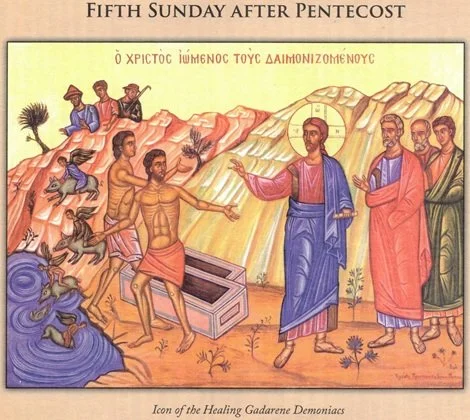
5th Sunday after Pentecost
Glory to Jesus Christ! Glory Forever!
5th Sunday After Pentecost
June 28, 2026
St. John the Baptist Byzantine Catholic
105 Kohler Ave
Lyndora PA 16045
Phone724-287-5000
www.stiohnbyzlyn.com
athanasius@zoominternet.net
Sat 6/27/26 4:00pm Vigil Divine Liturgy +Prokopchak Family by Maria and Michael Streitman
Sun 6/28/26 9:30am Divine Liturgy +Herbert and Margaret Moniot by Drew Moniot
Mon 6/29/26 9:30am Liturgy of S.S. Peter and Paul +Joseph & +Maria Pocchiari by Family
Wed 7/1/26 7:00pm Liturgy for deceased deacon Michael Meaders+ panachyda
Fri 7/3/26 7:00pm Moleben to Mary
Sat 7/4/26 4:00pm Vigil Divine Liturgy +Paul and +Helen Macko Michalco by Rebecca Michalco
Sun 7/5/26 9:30am Divine Liturgy +Wasyl Hoszwa by Rick and Irena Reeder
Variable Parts: Tone 4 - Pages 141 — 142
Epistle: Rom 10:1-10
Gospel: Matthew 8:28 - 9:3
Memorial Candle Request: No Candle Request
Epistle Readers: 27-Jun Mary Troyan 28-Jun Eva Babick 4-Jul John Baycura/Mary Motko 5-Jul Liz/John Pocchiari
Please Pray for: Lou Pocchiari, Erik Bergh, Mike Oshlick, Kathy Moyta, Dorothy Moyta, Brian Buchkovich, Lejen Warner, Sharon King, Ole J. Bergh, Liz Moyta, Fr. Michael Huszti, Fr. Laska, Susie Curcio, Teresa Milkovich, Robert Saper, Anna Habil, Mike Dancisin, Diane Sotak, Anna Pocchiari, Larry Hamil, Beverly Jones, Maryann Russin Schyvers, Nick Russin and Ken Konchan
Attendance: 6/20 - 19; 6/21 - 89
Collection: $1,864.00
Church Picnic: The Church Picnic will be held on Sunday, August 2nd at Connoquenessing Park.
The Faith & Fun Day for our Altar Servers - Monday, July 27. Details for the day are still being finalized.
Kindly remember in your prayers Deacon Michael Meaders who fell asleep in the Lord Thursday July 25. Deacon Michael was a retired Deacon of the Archeparchy who formerly served Holy Ghost Church on the North Side of Pittsburgh and came from this area.
Friends received:
Hughes Funeral Home
1501 Lowrie Street
Pittsburgh, Pa. 15212
Tuesday, June 30, 2026 from 1-3 and 6— 8 p.m. Parastas at 7:00 p.m.
Funeral Divine Liturgy:
Holy Ghost Church
1437 Superior Avenue
Pittsburgh Pa. 15212
Wednesday, July I, at 10:00 a.m. Interment will follow in Rose Hill Cemetery in Butler, Pa.
The Catholic Priest Who Forged a Lifelong Friendship With Harry Truman - There was no precedent in American history for a close personal friendship between a Catholic priest and an American president until Harry S. Truman succeeded Franklin Delano Roosevelt in April 1945. Although a lifelong Baptist, Truman considered Father Curtis Tiernan to be his best friend. Curtis Tiernan came from a prosperous Irish family in Kansas City, Missouri. After graduating from St. Louis University, he went to Rome in 1906 to study for the priesthood at the North American College. Four years later, he was ordained. When he returned to the United States, Father Tiernan worked at several parishes in western Missouri.
Meanwhile, Harry Truman, born in Lamar, Missouri, lived in Independence and Grandview. He worked on the family farm in Grandview and dabbled unsuccessfully in mining and oil ventures.
Neither Father Tiernan nor Truman knew yet that dramatic changes would occur in their lives when the United States got involved in World War I. The key to understanding the remarkable friendship between Father Tiernan and Truman was their membership in the 129th Field Artillery Regiment, which was composed largely of Missouri Catholics. Father Tiernan, a warm, likable man, had been asked by young men of the unit to serve as their chaplain. Honored by the request, the priest was eager to serve the soldiers. Harry Truman began as an enlisted soldier but his leadership skills soon advanced him to the rank of captain in the military unit. After the 129th Field Artillery Regiment was shipped abroad, both men deepened their friendship during the horrific battles on the Western Front. In their marches from one sector of the front to another, Father Tiernan and Truman had long, often profound, conversations.
"I used to walk at the head of my battery and lead my horses. Father Tiernan would walk with me," Truman said. "There were only five or six Protestants in my battery and I was one of them. All the rest were Catholics. Father Tiernan and I would walk along and discuss the history of the world and I don't know what all." Testimony to the mutual respect they shared, Truman often brought up controversial subjects like the thorny topic of the Spanish Inquisition. "Father Tiernan always had an answer for me. Of course, it was never the right answer as far as I was concerned," Truman said laughingly.
Truman admired Father Tiernan so much that he paid him the ultimate compliment, declaring, "If all priests were like him, there would be no Protestants."
Father Tiernan, known affectionately by the soldiers as "Padre," and Truman shared a deep loyalty to their men and displayed outstanding courage in battle. Like other outstanding chaplains in the military, Father Tiernan was in the middle of many bloody scenes of the war, responding to that summons from God that could not be denied. Despite heavy enemy fire during the Meuse-Argonne Offensive, he performed his duties at a dressing station and with a burial squad for two days and nights. He received the Silver Star, one of the highest military decorations for valor in combat. Throughout the war, Father Tiernan was always available to the soldiers, offering hope to the wounded and dying men of his military unit.
After World War I, Father Tiernan and Capt. Truman returned to civilian life. Truman opened a haberdashery in Kansas City. A few years later, he wisely turned to politics and became a county judge. In 1934, he was elected to the US Senate. Although Father Tiernan enjoyed pastoral work, he yearned to be a chaplain again in the US Army. "When it gets into your blood," he said, "you cannot get it out." He returned to military service in 1929. When the US entered World War II, Father Tiernan was one of 3,000 Catholic priests who served as military chaplains. Harry Truman became vice-presidential nominee in 1944 that nominated Franklin D. Roosevelt for a fourth term. No one anticipated that Roosevelt would die only a few months after his inauguration. The challenges that faced President Truman were enormous. Not only did he have to steer the American war machine to victory in Europe and Asia, a task yet unfinished, but also to deal with the myriad problems that the United States would inevitably face in the postwar era.
Father Tiernan wrote to Truman: "I know I should congratulate you but, knowing your extreme honesty and sincerity, I know a burden has been laid on your shoulders. From now on, Harry, you will have an intention in my daily Mass. "The priest went on to pray that "Almighty God will enlighten and strengthen you, that you will be, in his Providence, the most powerful agent in establishing a just and lasting peace on earth." Truman revealed the depth of his feeling when he replied to "Padre" Tiernan, "I know the reason now that I have been having good luck with the new job. I did not receive a note or letter I appreciated more than yours."
Truman's first major foreign policy challenge was the last meeting of the Big Three — Truman, Churchill and Stalin — at Potsdam in July 1945. Significantly, Truman personally invited Father Tiernan to be with him during this extremely difficult and significant time in world affairs. Truman wrote to his wife Bess and told her that he had attended Protestant church services as well as Mass, offered by Father Tiernan. "I guess I should stand in good with the Almighty for the coming week — and my how I'll need it. "Before Mass, he told Father Tiernan, "There 's one thing you've got to do. You've got to get every Protestant in this outfit to be sure and be at that Mass because if they're not, they will be in trouble with me!" Mass was well attended. Father Tiernan retired from the Army three years later. He and Truman saw each other many times after the war. "Padre" was also a frequent guest at the White House. Sadly, Father Tiernan's heart problems led to his death in 1960. President Truman was deeply shaken by the loss of his close friend. (from NationalCatholicRegister)
St. Peter and Paul were martyred during the persecution of Christians by Roman Emperor Nero (64-67). The first Christian historian, Bishop Eusebius of Ceasarea (3rd century) wrote: "Publicly announcing himself as the first among the enemies of God he (Nero) was led on to the slaughter of the Apostles. It is recorded that in his days Paul was beheaded in the city of Rome and that Peter, also, was crucified. This story is supported by the fact that the names of Peter and Paul are preserved in the cemeteries of that place even to the present day . . . For if you would go to the Vatican, or to the Ostian Way, you would find their trophies (monuments)".
Both Saint Peter and Saint Paul received new names, indicating a new relationship with God. Simon the fisherman became known as Cephas (John 1:42), or Peter after confessing Jesus as the Son of God (Mt.16:18). Saint Peter, the brother of Saint Andrew, was a fisherman on the sea of Galilee. He was married, and Christ healed his mother-in-law of a fever (Mt.8:14). He, with James and John, witnessed the most important miracles of the Savior's earthly life. Despite his earlier recognition of Christ as the Son of God, he denied Him three times on the night before the Crucifixion. Therefore, after His Resurrection, the Lord asked Peter three times if he loved Him. Then He told Peter to feed His sheep (John 21:15-17). After the descent of the Holy Spirit at Pentecost, Saint Peter addressed the crowd (Acts 2:14), and performed many miracles in Christ's name. He baptized Cornelius, the first Gentile convert (Acts 10:48). He was cast into prison, but escaped with the help of an angel (Acts 5:19). Saint Peter also traveled to many places in order to proclaim the Gospel message. He wrote two Epistles, which are part of the New Testament.
In Matthew 16:18-19, Jesus changed Simon's name to Peter (Cephas), which means rock, and said, "You are Peter [rock], and on this rock I will build my church, and the powers of death shall not prevail against it. I will give you the keys of the kingdom of heaven, and whatever you bind on earth shall be bound in heaven, and whatever you loose on earth shall be loosed in heaven." This passage is an allusion to Isaiah 22:22, which tells of how Israel's wicked chief steward Shebna was replaced with the righteous Eli'akim. Isaiah 22:22 said Eli'akim would have "the key of the house of David; he shall open, and none shall shut; and he shall shut, and none shall open." Just as King Hezekiah gave Eli'akim authority to oversee the kingdom of Israel, Christ gave Peter authority to oversee his Church (i.e., the "keys to the kingdom"), which included the authority to "bind and loose"—in other words, to determine official doctrine and practice.
The early Church Fathers recognized that Peter is the rock of whom Christ spoke when he said, "You are Peter and on this rock I will build my Church." Because Peter was made the foundation of the Church, there were practical implications: it gave him a special place or primacy among.the apostles. As the passages below demonstrate, the early Church Fathers clearly recognized this.
St. Peter spent his last years in Rome, leading the Church through persecution and eventually being martyred in the year 64. He was crucified upside-down at his own request, because he claimed he was not worthy to die as his Lord. He was buried on Vatican hill, and St. Peter's Basilica is built over his tomb.
St. Paul was the Apostle of the Gentiles. His letters are included in the writings of the New Testament, and through them we learn much about his life and the faith of the early Church.
Before receiving the name Paul, he was Saul, a Jewish pharisee who zealously persecuted Christians in Jerusalem. Scripture records that Saul was present at the martyrdom of St. Stephen. Saul's conversion took place as he was on his way to Damascus to persecute the Christian community there. As he was traveling along the road, he was suddenly surrounded by a great light from heaven. He was blinded and fell off his horse. He then heard a voice saying to him, "Saul, Saul, why do you persecute me?" He answered: "Who are you, Lord?" Christ said: "I am Jesus, whom you are persecuting." Saul continued to Damascus, where he was baptized and his sight was restored. He took the name Paul and spent the remainder of his life preaching the Gospel tirelessly to the Gentiles of the Mediterranean world. St. Paul was imprisoned and taken to Rome, where he was beheaded in the year 67.
St. Augustine of Hippo said of Sts. Peter and Paul: "Both apostles share the same feast day, for these two were one; and even though they suffered on different days, they were as one. Peter went first, and Paul followed