4th Sunday after Pentecost
Glory to Jesus Christ! Glory Forever!
4th Sunday After Pentecost
June 21, 2026
St. John the Baptist Byzantine Catholic
105 Kohler Ave
Lyndora PA 16045
Phone724-287-5000
www.stiohnbyzlyn.com
athanasius@zoominternet.net
Sat 6/20/26 4:00pm Vigil Divine Liturgy +Martha Sapar by Family
Sun 6/21/26 9:30am Divine Liturgy +Mark Simko by David and Lisa Simko
Wed 6/24/26 7:00pm Divine Liturgy
Fri 6/26/26 7:00pm Moleben to Sacred Heart of Jesus
Sat 6/27/26 4:00pm Divine Liturgy +Prokopchak Family by Maria and Michael Streitman
Sun 6/28/26 9:30am Divine Liturgy +Herbert and Margaret Moniot by Drew Moniot
Mon 6/29/26 9:30am Liturgy of Peter and Paul +Joseph & +Maria Pocchiari by Family
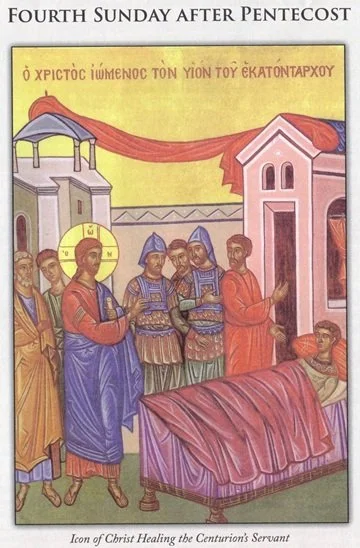
Variable Parts: Tone 3 - Pages 135 — 137; Epistle: Romans 6:18-23; Gospel Matthew 8 :5-13
Memorial Candle Request: No Candle Request
Epistle Readers 20-Jun John Baycura/Mary Motko 21-Jun Shari Allen 27-Jun Mary Troyan 28-Jun Eva Babick
Please Pray for: Lou Pocchiari, Erik Bergh, Mike Oshlick, Kathy Moyta, Dorothy Moyta, Brian Buchkovich, Lejen Warner, Sharon King, Ole J. Bergh, Liz Moyta, Fr. Michael Huszti, Fr. Laska, Susie Curcio, Teresa Milkovich, Robert Saper, Anna Habil, Mike Dancisin, Diane Sotak, Anna Pocchiari, Larry Hamil, Beverly Jones, Maryann Russin Schyvers, Nick Russin and Ken Konchan
Attendance: 6/13 - 17; 6/14 - 95 Collection: 6/13&6/14 - $2,093.00
Church Picnic: The Church Picnic will be held on Sunday, August 2" at Connoquenessing Park.
2026 GCU Byzantine Family Day at Kennywood July 23. Price: $28 - /ages 4 +/ Free - /ages 3 and under / Deadline to Order- July 9th. https://gcuusa.com/geu-event
Pope Leo XIV has emphasized the value of the Eastern Catholic Churches, warning that failing to understand them is harmful to the Church. In a private audience with members of the Reunion of Aid Agencies for the Oriental Churches on June 18, pope Leo highlighted the great gift of the Eastern Churches in communion with Rome. He also explained that these Churches offer Catholics a rich diversity, often unknown to the wider Church.: "Yes, the Eastern Catholic Churches have a great gift to offer the entire Catholic community, which is often unaware of the diverse ecclesial traditions within its ranks... . The Christian East can only be preserved if it is understood: to lose that understanding is to impoverish the Church."
"The Eastern Catholic communities preserve many of these [spiritual riches], sharing them with their brothers and sisters in the Orthodox Churches. It is good for us to delve deeper into these treasures together with millions of our Eastern Catholic brothers and sisters, as we look forward to progress toward full unity with all the Eastern Churches."
Happy Father's Day to all who are, or have, grandfathers, fathers or stepfathers! These holidays of our culture are not exactly high holy days of the Church, but they do give us reason to pause, to pray for and to reflect on our fathers whom we honor. Today we celebrate, congratulate and pray for the men who continue to reflect the Divine qualities of fatherhood as they lovingly establish, nourish and maintain their families. Fathers are a blessing, and we thank them for blessing us with lives of dedication, endurance and love.
Historical note: The observance most similar to our Father's Day was the ancient Roman Parentalia, which lasted from the thirteenth of February to the twenty-second. This festival, however, was not for living fathers, but was rather a time of remembrance, commemorating departed parents and kinsfolk. The ceremonies were held, Ovid says, to "appease the souls of your fathers." This annual observance became a family reunion.
Members offered wine, milk, honey, oil and water at the flower-decorated graves. At the concluding ceremony, known as the Caristia, much celebrating went on as the living relatives feasted together, having been cleansed by the performance of their duties to the dead. Father's Day for us, of course, is not intended for honoring the dead. We may pay a minor symbolic tribute by wearing a white rose in memory of deceased fathers. The origin of Father's Day. The originator and promoter of Father's Day was Mrs. John Bruce Dodd (Sonora Smart Dodd), of Spokane, Washington. The idea of a Father's Day celebration came to her first while listening to a sermon on Mother's Day in 1909. Her own father, William Jackson Smart, had accomplished the amazing task of rearing six children — Mrs. Dodd and her five brothers — after his young wife had died. The sacrifices her father made on their eastern Washington farm called to mind the unsung feats of fathers everywhere. Mrs. Dodd's idea was approved by her church and publicized by the YMCA. In 1910, the mayor of Spokane issued a Father's Day Proclamation and Governor M.E. Hay, set the date for an observance throughout the state. Mrs. Dodd's suggestions for observing the day included wearing a flower — a red rose to indicate a living father and a white rose for a deceased father. By 1924, the custom had spread through the country, and Calvin Coolidge made the first Presidential proclamation in support of Father's Day. Nearly 50 years later, (1972), President Richard Nixon made the holiday permanent, requesting that Congress pass a joint resolution to establish the third Sunday in June as a National Day of Observance in honor of fathers everywhere.
The Father's role in the family and in the society. Some recent studies have demonstrated how important a father is to his child's development. Children raised with fathers present have lower rates of delinquency, drug and alcohol use, teen pregnancy, and so on, than those with absent fathers. The father's presence is also a significant positive factor in children's getting a college education, finding a satisfying job, and making a lasting marriage. Psychotherapists today are saying that both parents are vitally important to the stable development of their children; the mother's input is invaluable in the formative pre-adolescent years, but the father's most important influence is at adolescence. Single mothers tell us that it is terribly difficult to teach their children about the meaning of God the Father Who seems so impersonal because their children have been abandoned by their natural fathers. Adolescent daughters long to hear from their fathers that they are beautiful and loved. In fact, a girl's choice of partner and satisfaction in marriage is often directly related to the relationship she has had with her father. According to the Catechism of the Catholic Church, the vital importance of the father's role comes from the fact that, with his wife, he cooperates with God the Creator in bringing a new human life into the world. There is no power greater than that (#2367).
The ideal and the reality: Many fathers today are role models like St. Thomas More and St. Louis Martin (father of the Little Flower), heroes of our Faith. Even in these days, fathers are expected to be the providers for, and the protectors of, the family. They are also supposed to be attuned emotionally and spiritually to their wives and children and to be able to balance careers with family life. Fathers struggle to overcome temptation and conflict. They make sacrifices day after day for their families. They try to give their youngsters the kind of model that, surely, they deserve above all else, a model of goodness, holiness, faith, trust in God and fidelity to the teachings of the Church. This is what Father's Day should remind us of. This is a time for all fathers to reflect upon their duties as responsible and well-integrated men. True fatherhood demands commitment. Commitment demands maturity, sacrifice, and love. Fatherhood also demands responsibility. Every true father will take responsibility for all of his actions. Our nation has an urgent need for good fathers.