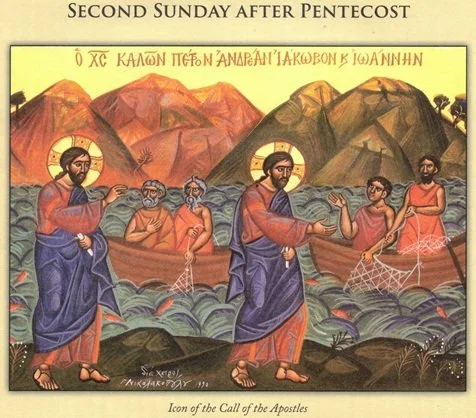
2nd Sunday after Pentecost
Glory to Jesus Christ! Glory Forever!
Sunday of All Saints
June 7, 2026
St. John the Baptist Byzantine Catholic
105 Kohler Ave
Lyndora PA 16045
Phone724-287-5000
www.stiohnbyzlyn.com
athanasius@zoominternet.net
Sat 6/6/26 4:00pm Vigil Divine Liturgy +Anna Olen by Cindy Hills
Sun 6/7/26 9:30am Divine Liturgy +Eva Dano by Children
Wed 6/10/26 7:00pm Liturgy for Healing
Fri 6/12/26 7:00pm Moleben to Sacred Heart of Jesus
Sat 6/13/26 4:00pm Vigil Divine Liturgy +Abbot Leo by Valerie Rodenbucher
Sun 6/14/26 9:30am Divine Liturgy +Stanley Gawlikoski by Drew Moniot
Variable Parts: Tone 1 - Pages 125 — 127
Epistle: Romans 2:10-16
Gospel: Matthew 4:18 - 23
Memorial Candle Request: +Rosalie Wondolkowski by Lorri & Jeff Pakutz
Epistle Readers 6-Jun John Baycura/Mary Motko 7-Jun Mike Dancisin 13-Jun Mary Troyan 14-Jun Kathy Moyta
Please Pray for: Erik Bergh, Mike Oshlick, Kathy Moyta, Dorothy Moyta, Brian Buchkovich, Lejen Warner, Sharon King, Ole J. Bergh, Liz Moyta, Fr. Michael Huszti, Fr. Laska, Susie Curcio, Teresa Milkovich, RobertSaper, Anna Habil, Mike Dancisin, Diane Sotak, Anna Pocchiari, Larry Hamil, Beverly Jones, Maryann Russin Schyvers, Nick Russin and Ken Konchan
Attendance: 5/23 — 23; 5/24 — 91; 5/25 — 14; 5/30 — 19; 5/31 — 75 Collection: 5/23 & 5/24 $2,245.44; 5/30 & 5/31 - $2,209.00
Parish Council Meeting: on Monday, June 8th at 6:30pm in the church hall.
Flag Day Ceremony: Our Flag Day celebration will take place on Sunday June 14 after the Divine Liturgy. Lunch will be provided by our Ladies Guild and the GCU.
Church Picnic: The Church Picnic will be held on Sunday. August 2nd at Connoquenessing Park.
Catechesis on prayer - 4. The prayer of the righteous - God's plan for humanity is good, but in our daily affairs we experience the presence of evil. It is a daily experience. The first chapters of the Book of Genesis describe the progressive expansion of sin in human affairs. Adam and Eve (cf. Gen 3:1-7) doubt God's good intentions; they think they are dealing with an envious God who impedes their happiness. This is where their rebellion comes from: they no longer believe in a generous Creator who desires their happiness. Yielding to the temptation of evil, their hearts are overcome by a delirium of omnipotence: 'if we eat the fruit from the tree we will become like God' (cf. v. 5). And this is temptation: this is ambition that enters hearts. But their experience goes in the opposite direction: their eyes are opened and they discover they are naked (cf. v. 7), with nothing. Do not forget this: the tempter is a bad payer, he does not pay well.
Evil becomes even more disruptive with the second human generation, it is stronger: it is the story of Cain and Abel (cf. Gen 4:1-16). Cain is envious of his brother; there is the seed of envy; even though he is the first born, he sees Abel as a rival, one who undermines his primacy. Evil appears in his heart and Cain is unable to control it. Evil begins to enter his heart: his thoughts are always turned to looking badly upon the other, with suspicion. And this occurs with his thoughts too: "This one is evil, he will hurt me". And this thought enters his heart ....And thus the story of the first brotherhood ends in murder. I think of human fraternity today... war everywhere. In Cain's descendants, arts and crafts develop, but violence develops too, expressed by the sinister canticle of Lamech, which sounds like a hymn of revenge: "I have killed a man for wounding me, a young man for striking me, if Cain is avenged seven times, truly Lamech seventy-sevenfold" (4:23-24). Vengeance: "You did this, you will pay". But the judge does not say this, I do. And I make myself the judge of the situation. And in this way evil spreads like wildfire, until it occupies the entire picture: "The Lord saw that the wickedness of man was great in the earth, and that every imagination of the thoughts of his heart was only evil continually" (6:5). The great frescos of the universal flood (ch. 6-7) and of the tower of Babel (ch. 11) reveal that there is need of a new beginning, like a new creation, which will be fulfilled in Jesus Christ. Yet, in these first pages of the Bible, another, less striking, much more humble and pious story is also written, which represents the release of hope. While almost everyone behaves in a wicked manner, making hatred and conquest the great engine of human affairs, there are people who are capable of praying to God with sincerity, capable of writing mankind's destiny in a different way. Abel offers God the firstling sacrifice. After his death, Adam and Eve had a third son, Seth, to whom Enosh (which means 'mortal') was born, and it is stated: "At that time men began to call upon the name of the Lord". (4:26). Then Enoch appears, a person who "walked with God" and was taken to heaven (cf. 5:22, 24). And lastly there is the story of Noah, a righteous man who "walked with God" (6:9), before whom God withheld his intention to blot out mankind (cf. 6:7-8).
While reading these narratives, one has the impression that prayer is a bulwark; it is man's refuge before the flood wave of evil that grows in the world. On closer inspection, we also pray to be saved from ourselves. It is important to pray: "Lord, please, save me from myself from my ambitions, from my passions". The prayerful of the first pages of the Bible are peace workers: indeed, when prayer is authentic, it frees one from the instincts of violence and it is a gaze directed to God, that he may return to take care of the heart of mankind. We read in the Catechism: "This kind of prayer is lived by many righteous people in all religions" (ccc, 2569). Prayer cultivates flowerbeds of rebirth in places where man's hatred has only been able to expand 'the desert. And prayer is powerful because it attracts the power of God and the power of God always gives life: always. He is the God of life and he causes rebirth.
This is why God's lordship passes through this chain of men and women, often misunderstood or marginalized in the world. But the world lives and grows thanks to the power of God whom these servants attract with their prayer. It is not at all a boisterous chain, and rarely makes headlines, yet it is so important to restoring trust to the world! I remember the story of one man: an important government leader not from these days, but from the past. An atheist who had no religious feeling in his heart, but as a child he heard his grandmother pray, and this remained in his heart. And at a very difficult time in his life, that memory returned to his heart and said: "But my grandmother used to pray...". He thus began to pray with his grandmother's formulas, and there he found Jesus. Prayer is always a chain of life: many men and women who pray sow life.
Prayer sows life, small prayers: this is why it is so important to teach children to pray. I suffer when I encounter children who do not know how to make the sign of the Cross. They have to be taught to make the sign of the Cross properly, because it is the first prayer. Then perhaps they may forget, take another path, but the first prayers learned as a child remain in the heart, because they are a seed of life, the seed of dialogue with God. The journey of God in the history of God is conveyed through them: it has passed through a "remainder" of humanity that has not conformed to the law of the fittest, but has asked God to perform his miracles, and above all to transform our hearts of stone into hearts of flesh (cf. Ez 36:26). And this helps prayer: because prayer opens the door to God, turning our often stony hearts into a human heart. And this demands a lot of humanity, and with humanity one can pray well.
The Holy Apostle Bartholomew was born at Cana of Galilee and was one of the Twelve Apostles of Christ. After the Pentecost, it fell by lot to the holy Apostles Bartholomew and Philip to preach the Gospel in Syria and Asia Minor. Traversing the cities of Syria and Myzia, they underwent much hardship and tribulations. After this mission, the Apostle Bartholomew went to India, where he translated the Gospel of Matthew into their language, and he converted many pagans to Christ. He also visited Greater Armenia, where he worked many miracles and healed the daughter of King Polymios from the demons afflicting her. Then Polymios together with his family accepted Baptism. And people from more than ten cities of Greater Armenia followed their example. But through the intrigues of the pagan priests, the Apostle Bartholomew was seized by the king's brother Astiagus in the city of Alban (now the city of Baku), and crucified upside down. But even from the cross he did not cease to proclaim the good news about Christ the Savior. Finally, on orders from Astiagus, they flayed the skin from the Apostle Bartholomew and cut off his head.