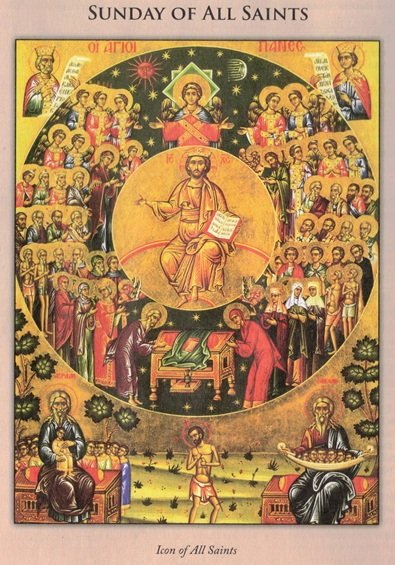
All Saints Sunday
Glory to Jesus Christ! Glory Forever!
Sunday of All Saints
May 31, 2026
St. John the Baptist Byzantine Catholic
105 Kohler Ave
Lyndora PA 16045
Phone724-287-5000
www.stiohnbyzlyn.com
athanasius@zoominternet.net
Sat 5/30/26 4:00pm Vigil Divine Liturgy +Prokopchak Family by Maria and Michael Streitman
Sun 5/31/26 9:30am Divine Liturgy +Ed and +Paula Himchack by Drew Moniot
Wed 6/3/26 7:00pm Liturgy for Healing
Fri 6/5/26 7:00pm Moleben to Sacred heart of Jesus
Sat 6/6/26 4:00pm Vigil Divine Liturgy +Anna Olen by Cindy Hills
Sun 6/7/26 9:30am Divine Liturgy +Eva Dano by Children
Variable Parts: Tone 8 - Pgs 161 - 162 Sunday of All Saints 211 — 213
Epistle: Hebrews 11:32-12:2a
Gospel: Matthew 10:32-33, 37-38 & 19:27-30
Memorial Cand le Request: No Candle Request
Epistle Readers 30-May Mary Troyan 31-May Joel Hills 6-Jun John Baycura/Mary Motko 7-Jun Mike Dancisin
Please Pray for: Erik Bergh, Mike Oshlick, Kathy Moyta, Dorothy Moyta, Brian Buchkovich, Lejen Warner, Sharon King, Ole J. Bergh, Liz Moyta, Fr. Michael Huszti, Fr. Laska, Susie Curcio, Teresa Milkovich, Robert Saper, Anna Habil, Mike Dancisin, Diane Sotak, Anna Pocchiari, Larry Hamil, Beverly Jones, Maryann Russin Schyvers, Nick Russin and Ken Konchan
Flag Day Ceremony: Our Flag Day celebration will take place on Sunday June 14 after the Divine Liturgy. Lunch will be provided by our Ladies Guild and the GCU.
Church Picnic: The Church Picnic will be held on Sunday, August 2nd at Connoquenessing Park.
Physical Media Orders of Church History Video: For those of you that requested a physical copy of our church history video, they are ready. The price is $10 for the DVD as well as the USB 3.2 flash drive. The flash drives are backward compatible with USB 2.0 systems. I will call each of you and arrange to get your physical medium to you. — John Baycura
The historic Christian practice of asking our saints for their intercession has come under attack in the last few hundred years. Though the practice dates to the earliest days of Christianity and is shared by Catholics, Eastern Orthodox, the other Eastern Christians, and even some Anglicans, it still comes under heavy attack from many within the Protestant movement that started in the sixteenth century.
Can Saints Hear Us? One charge made against it is that the saints in heaven cannot even hear our prayers, making it useless to ask for their intercession. But as Scripture indicates, those in heaven are aware of the prayers of those on earth. This can be seen, for example, in Revelation 5:8, where John depicts the saints in heaven offering our prayers to God under the form of "golden bowls full of incense, which are the prayers of the saints." But if the saints in heaven are offering our prayers to God, then they must be aware of our prayers.
Some might try to argue that in this passage the prayers being offered were not addressed to the saints in heaven, but directly to God. Yet this argument would only strengthen the fact that those in heaven can hear our prayers, for then the saints would be aware of our prayers even when they are not directed to them!
One Mediator Between God and Men Another charge commonly levelled against asking the saints for their intercession is that this violates the sole mediatorship of Christ, which Paul discusses: "For there is one God, and there is one mediator between God and men, the man Christ Jesus" (1Tim. 2:5). But asking one person to pray for you in no way violates Christ's mediatorship.
The intercession of fellow Christians—which is what the saints in heaven are—clearly does not interfere with Christ's unique mediatorship because in the four verses immediately preceding 1Timothy 2:5, Paul says that Christians should intercede: "First of all, then, I urge that supplications, prayers, intercessions, and thanksgivings be made for all men, for kings and all who are in high positions, that we may lead a quiet and peaceable life, godly and respecffid in every way. This is good, and pleasing to God our Savior, who desires all men to be saved and to come to the knowledge of the truth" (1Tim. 2:1-4). Clearly, then, intercessory prayers offered by Christians on behalf of others is something "good and pleasing to God," not something infringing on Christ's role as mediator.
"No Contact with the dead" Sometimes Fundamentalists object to asking our fellow Christians in heaven to pray for us by declaring that God has forbidden contact with the dead in passages such as Deuteronomy 18:1011. In fact, he has not, because he at times has given it—for example, when he had Moses and Elijah appear with Christ to the disciples on the Mount of Transfiguration (Matt. 17:3). What God has forbidden is the necromantic practice of conjuring up spirits. "There shall not be found among you any one who . . . practices divination; a soothsayer, or an augur, or a sorcerer, or a charmer, or a medium, or a wizard, or a necromancer. . . . For these nations, which you are about to dispossess, give heed to soothsayers and to diviners; but as for you, the Lord your God has not allowed you so to do." (Deut. 18:10-15).
God thus indicates that one is not to conjure the dead for purposes of gaining information; one is to look to God's prophets instead. Thus, one is not to hold a seance. But anyone with an ounce of common sense can discern the vast qualitative difference between holding a seance to have the dead speak through you and a son humbly saying at his mother's grave, "Mom, please pray to Jesus for me; I'm having a real problem right now."
Praying to Saints: Overlooking the Obvious Some objections to the concept of prayer to the saints betray restricted notions of heaven. One comes from anti-Catholic Loraine Boettner: "How, then, can a human being such as Mary hear the prayers of millions of Roman Catholics, in many different countries, praying in many different languages, all at the same time?" If being in heaven were like being in the next room, then of course these objections would be valid. A mortal, unglorified person in the next room would indeed suffer the restrictions imposed by the way space and time work in our universe. But the saints are not in the next room, and they are not subject to the time/space limitations of this life. This does not imply that the saints in heaven therefore must be omniscient, as God is, for it is only through God's willing it that they can communicate with others in heaven or with us. And Boettner's argument about petitions arriving in different languages is even further off the mark. Does anyone really think that in heaven the saints are restricted to the King's English? After all, it is God himself who gives the gift of tongues and the interpretation of tongues. Surely those saints in Revelation understand the prayers they are shown to be offering to God. Source: www.catholic.com
Given its profound implications for the workforce, the environment, and humankind as a whole, it's no surprise that almost everyone has an opinion on artificial intelligence. Pope Leo XIV just released his first encyclical, a pastoral letter aimed to offer guidance titled Magnifica Humanitas: On Safeguarding the Human Person in the Time of Artificial Intelligence. "Humanity, created by God in all its grandeur, is today facing a pivotal choice: either to construct a new Tower of Babel or to build the city in which God and humanity dwell together. ... The technology is not "a force antagonistic to humanity", nor is it "inherently evil". However, "technology is never neutral, because it takes on the characteristics of those who devise, finance, regulate, and use it. Therefore, Pope Leo XIV appeals for people to build "for the common good" and to "remain human," following a courageous mentality of shared responsibility and communion, so that the world "will come to recognize the human heart as the place where God desires to dwell". "Calling for prudence, rigorous evaluation and even, at times, a slower pace in adopting AI does not mean opposing progress," Pope Leo wrote. "Instead, it is an exercise of responsible care for the human family."