Pentecost Sunday
St. John the Baptist Byzantine Catholic
105 Kohler Ave
Lyndora PA 16045
Phone 724-287-5000
www.stjohnbyzlyn.comathanasius@zoominternet.net
Glory to Jesus Christ! Glory Forever!
Pentecost Sunday
May 24, 2026
Sat 5/23/26 4:00pm Vigil Divine Liturgy of Pentecost +Jane Prokopchak by Betty Lou & John Nemcek
Sun 5/24/26 9:30am Pentecost Divine Liturgy For All Parishioners
Mon 5/25/26 9:30am Divine Liturgy Robert & Elizabeth Wedding Anniversary
Wed 5/27/26 7:00pm Liturgy for Healing
Fri 5/29/26 7:00pm Moleben to Jesus
Sat 5/30/26 4:00pm Vigil Divine Liturgy +Prokopchak Family by Maria and Michael Streitman
Sun 5/31/26 9:30am Divine Liturgy +Ed and +Paula Himchack by Drew Moniot
Variable Parts Pentecost Sunday- pgs 203 —208
Epistle: Acts 2:1-11
Gospel: John 7:37-52 & 8:12
Memorial Candle Request: No Candle Request
Epistle Readers 23-May John Baycura/Mary Motko 24-May Amanda Stavish 30-May Mary Troyan 31-May Joel Hills
Please Pray for: Erik Bergh, Mike Oshlick, Kathy Moyta, Dorothy Moyta, Brian Buchkovich, Lejen Warner, Sharon King, Ole J. Bergh, Liz Moyta, Fr. Michael Huszti, Fr. Laska, Susie Curcio, Teresa Milkovich, 'Robert Saper, Anna Habil, Mike Dancisin, Diane Sotak, Anna Pocchiari, Larry Hamil, Beverly Jones, Maryann Russin Schyvers, Nick Russin and Ken Konchan
Attendance: 5/13 — 17: 5/14 — 19: 5/16 — 19: 5/17 — 82 Collection: $1,824.00
Student Food Pantry: May donations will be any canned food item, including Chef Boyardee items. Please consider donating to help with the summer months break. We will resume mid-August to help with the September back to school drive. Thank you for all the donations this past school year! Any questions, please contact Pam Gagen.
Flag Day Ceremony: Our Flag Day celebration will take place on Sunday June 14 after the Divine Liturgy. Lunch will be provided by our Ladies Guild and the GCU.
Church Picnic: The Church Picnic will be held on Sunday, August 2nd at Connoquenessing Park.
Participant registration for the UPMC for Life Medicare Faith and Wellness Program ends May 24 The program is for all those who are on Medicare program. Each participant can earn 50 dollars for successful participation and brings the same amount for the church.
Registration Options:
1. Direct Online Registration at upmchp.us/wellness-registration Please feel free to share this link via text message or email so participants can register directly. Participant can be even a person who does not belong to the church.
2. Paper Registration Form:
In the Old Testament Pentecost was the feast which occurred fifty days after Passover- feast day of Shavu'ot. As the passover feast celebrated the exodus of the Israelites from the slavery of Egypt, so Shavu'ot -Pentecost celebrated God's gift of the ten commandments to Moses on Mount Sinai. Every year, the Jewish people renew their acceptance of the gift of the Torah on this feast. In the new covenant of the Messiah, the passover event takes on its new meaning as the celebration of Christ's death and resurrection, the "exodus" of men from this sinful world to the Kingdom of God. And in the New Testament as well, the pentecostal feast is fulfilled and made new by the coming of the "new law," the descent of the Holy Spirit upon the disciples of Christ. When the day of Pentecost had come they were all together in one place. And suddenly a sound came from heaven like the rush of a mighty wind, and it filled all the house where they were sitting. And there appeared to them tongues as of fire, distributed as resting upon each one of them. And they were all filled with the Holy Spirit . . . (Acts 2.1-4).
The timing of these feasts is also where Catholics get the concept of the novena — nine days of prayer — because in Acts 1, Mary and the Apostles prayed together "continuously" for nine days after the Ascension leading up to Pentecost. Traditionally, the Church prays the novena to the Holy Spirit in the days before Pentecost. The Holy Spirit that Christ had promised to his disciples came on the day of Pentecost (Jn 14.26, 15.26; Lk 24.49; Acts 1.5). The apostles received "the power from on high," and they began to preach and bear witness to Jesus as the risen Christ, the King and the Lord. This moment has traditionally been called the birthday of the Church.
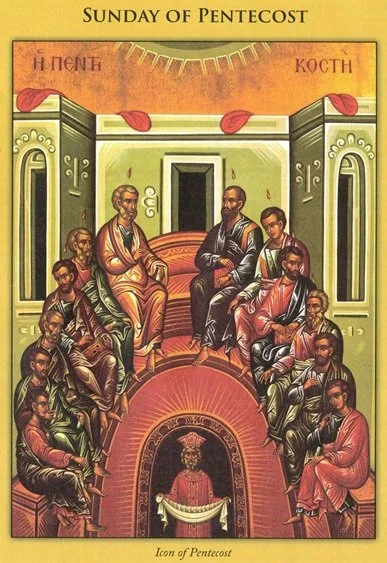
In the liturgical services of the feast of Pentecost, the coming of the Holy Spirit is celebrated together with the full revelation of the divine Trinity: Father, Son, and Holy Spirit. The fullness of the Godhead is manifested with the Spirit's coming to man, and the Church hymns celebrate this manifestation as the final act of God's self-disclosure and self-donation to the world of His creation. For this reason Pentecost Sunday is also called Trinity Day in the Byzantine tradition. Often on this day the icon of the Holy Trinity is placed in the center of the church. This icon is used with the traditional pentecostal icon which shows the tongues of fire hovering over Mary and the Twelve Apostles, the original prototype of the Church, who are themselves sitting in unity surrounding a symbolic image of "cosmos," the world. On Pentecost we have the final fulfillment of the mission of Jesus Christ and the first beginning of the messianic age of the Kingdom of God mystically present in this world in the Church of the Messiah. For this reason the fiftieth day stands as the beginning of the era which is beyond the limitations of this world, fifty being that number which stands for eternal and heavenly fulfillment in Jewish and Christian mystical piety: seven times seven, plus one. Thus, Pentecost is called an apocalyptic day, which means the day of final revelation. It is also called an eschatological day, which means the day of the final and perfect end (in Greek eschaton means the end). For when the Messiah comes and the Lord's Day is at hand, the "last days" are inaugurated in which "God declares: ... I will pour out my Spirit upon all flesh." ; This is the ancient prophecy to which the Apostle Peter refers in the first sermon of the Christian Church which was preached on the first Sunday of Pentecost (Acts 2: 1 7). Once again it must be noted that the feast of Pentecost is not simply the celebration of an event which took place centuries ago. It is the celebration of what must happen and does happen to us in the Church today. We all have died and risen with the Messiah-King, and we all have received his Most Holy Spirit. We are the "temples of the Holy Spirit." God's Spirit dwells in us (Rom 8; 1 Cor 2-3, 12). We have received "the seal of the gift of the Holy Spirit" in the sacrament of Chrismation. Pentecost has happened to us.
Customs: The church building is decorated with flowers and the green leaves of the summer to show that God's divine Breath comes to renew all creation as the "life-creating Spirit." In Hebrew the word for Spirit, breath and wind is the same word, ruah. Typically, in Roman Catholic church priests will wear red vestments on Pentecost, symbolic of the burning fire of God's love and the tongues of fire that descended on the apostles. However, in some parts of the world, Pentecost is also referred to as "WhitSunday", or White Sunday, referring to the white vestments that are typically worn in Britain and Ireland. The white is symbolic of the dove of the Holy Spirit, and typical of the vestments that catechumens desiring baptism wear on that day.
An Italian Pentecost tradition is to scatter rose leaves from the ceiling of the churches to recall the miracle of the fiery tongues, and so in some places in Italy, Pentecost is sometimes called Pascha Rosatum (Easter roses). In France, it is tradition to blow trumpets during Mass to recall the sound of the driving wind of the Holy Spirit. In Asia, it is typical to have an extra service, called genuflexion, during which long poems and prayers are recited. In Our Byzantine tradition green branches are used for decoration during Pentecost services.