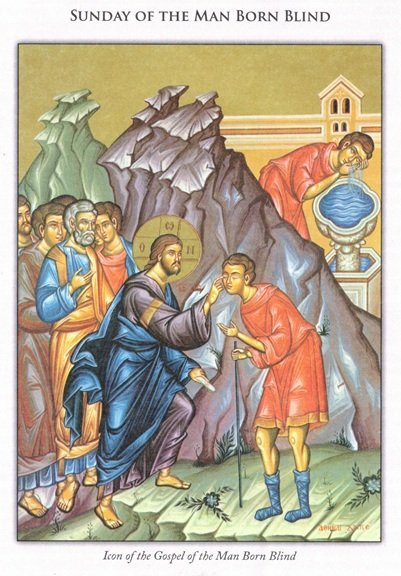
Sunday of the Man Born Blind
Christ is Risen! Indeed He is Risen!
Sunday of the Man Born Blind
May 3, 2026
Sat 5/9/26 4:00pm Vigil Divine Liturgy +Mary Cupps by Cindy Hills
Sun 5/10/26 9:30am Divine Liturgy +Karen Bohin by Andy Bohin & Family
Wed 5/6/26 7:00pm Vigil Divine Liturgy of Ascension of Our Lord
Thu 5/14/26 9:30am Divine Liturgy Ascension of Our Lord
Fri 5/15/267:00pm Akathist
Sat 5/16/26 4:00pm Vigil Divine Liturgy +Martha Sapar by Family
Sun 5/17/26 9:30am Divine Liturgy +John Kavchak by Drew Moniot
Variable Parts: Sunday of the Man Born Blind Festal Tone Pgs 189 - 195
Epistle Acts 16:16-34
Gospel John 9:1-38
Memorial CandleRequest:No Candle Request
Epistle Readers: 9-May John Baycura/Mary Motko 10-May Eva Babick 16-May Mary Troyan 17-May Liz/John Pocchiari
Please Pray for: Erik Bergh, Mikc Oshlick, Kathy Moyta, Dorothy Moyta, Brian Buchkovich, Lejen Warner, Sharon King, Ole J. Bergh, Liz Moyta, Fr. Michael Huszti, Fr. Laska, Susie Curcio, Teresa Milkovich, Robert Saper, Anna Habil, Mike Dancisin, Diane Sotak, Anna Pocchiari, Larry Hamil, Beverly Jones, Maryann Russin Schyvers, Nick Russin and Ken Konchan
Student Food Pantry: May donations will be any canned food item, including Chef Boyardee items. Please consider donating to help with the summer months break. We will resume mid-August to help with the September back to school drive. Thank you for all the donations this past school year! Any questions, please contact Pam Gagen.
Church History and 75th Anniversary video: During the presentation, there was interest to obtain a physical copy of it. If you are interested, please sign the sheet on the bulletin board indicating the format you'd prefer. The available options are DVD or USB drive. A price will be determined on the cost of reproduction. The video will be available online as well. The deadline to request a copy is Sunday May 17th.
ECF/Youth Group Picnic: The "End of school year celebration picnic will be held Saturday, May 16th at 12:30pm at Moraine State Park North Shore Beach. RSVP to Amanda at 724-272-2963 by May 12th.
Catechesis on prayer 2. The prayer of a Christian - Prayer belongs to everyone: to men and women of every religion, and probably also to those who profess none. Prayer arises in our innermost self, in that interior place that spiritual authors call "heart" (cf. Catechism of the Catholic Church, 2562-2563). Therefore, it is not something peripheral that prays within us, it is not some secondary and marginal ability that we have, but rather it is our most intimate mystery. It is this mystery that prays. Feelings pray, but one cannot say that prayer is only feeling. Intelligence prays, but praying is not simply an intellectual act. The body prays, but one can speak with God even having the most serious disability. Thus the entire man prays if he prays with his "heart".
Prayer is an impulse; it is an invocation that goes beyond ourselves: something that is born in the intimacy of our person and extends, because it senses the nostalgia of an encounter. That nostalgia which is more than a need, more than a necessity: it is a path. Prayer is the voice of an "I" that fumbles, that proceeds unsteadily in search of a "You". The encounter between the "I" and the "You" cannot occur via calculators: it is a human encounter and we often proceed unsteadily in order to find the "You" that my "I" is seeking.
Instead, the prayer of a Christian arises from a revelation: the "You" did not remain shrouded in mystery, but rather entered into a relationship with us. Christianity is the religion that continually celebrates God's "manifestation", that is, his epiphany.
The first feasts of the liturgical year are the celebration of this God who does not remain hidden, but rather offers his friendship to mankind. God reveals his glory in the poverty of Bethlehem, in the contemplation of the Magi, in the baptism in the River Jordan, in the miracle of the wedding at Cana. The Gospel of John concludes the great hymn of the Prologue with a concise affirmation,: "No one has ever seen God; the only Son, who is in the bosom of the Father, he has made him known" (1:18). It was Jesus who revealed God to us.
The prayer of a Christian enters into a relationship with the God of the most tender face, who does not wish to instill any fear in men and women. This is the first characteristic of Christian prayer. While men and women had always been accustomed to drawing near to God somewhat intimidated, somewhat fearful of this fascinating and tremendous mystery, while they had been accustomed to worshiping him with a servile attitude, similar to that of a vassal who does not wish to disrespect his lord, Christians instead address him by daring to call him intimately with the name, "Father". Indeed, Jesus uses the other word: "Dad". Christianity has banned all "feudal" relationships from the bond with God. In the heritage of our faith there are no expressions such as "subjection", "slavery" or "servitude"; but rather, words like "covenant", "friendship", "promise", "communion", "closeness". In his long farewell discourse to his disciples, Jesus says this: "No longer do I call you servants, for the servant does not know what his master is doing; but I have called you friends, for all that I have heard from my Father I have made known to you. You did not choose me, but I chose you and appointed you that you should go and bear fruit and that your fruit should abide; so that whatever you ask the Father in my name, he may give it to you" (Jn 15:1516). But this is a blank cheque: "whatever you ask the Father in my name, I will give to you"!
God is a friend, an ally, a spouse. In prayer one can establish an intimate relationship with him, so much so that in the "Our Father" Jesus taught us to address to him a series of questions. We can ask God everything, everything; explain everything, recount everything. It does not matter if we feel flawed in our relationship with God: we are not good friends, we are not grateful children, we are not faithful spouses. He continues to love us. It is what Jesus shows definitively at the Last Supper when he says: "This cup which is poured out for you is the new covenant in my blood' (Lk 22:20).
With that gesture in the Upper Room, Jesus foreshadows the mystery of the Cross. God is a faithful ally: if men and women cease to love him, he nevertheless continues to love, even if love leads him to Calvary. God is always close to our heart's door and he waits for us to open it to him. And sometimes he knocks on the heart, but he is not intrusive: he waits. God's patience with us is the patience of a father, of one who loves us dearly. I would say it is the combined patience of a father and a mother. Always close to our heart, and when he knocks he does so with tenderness and with much love.
Let us all try to pray this way, by entering the mystery of the Covenant. To place ourselves through prayer into the merciful arms of God, to feel enveloped by that mystery of happiness which is Trinitarian life, to feel like guests who were not worthy of so much honour. And to repeat to God in the wonder of prayer: how can you know only love? He does not know hatred. He is hated but he does not know hatred. He knows only love. This is the God to whom we pray. This is the incandescent core of all Christian prayer. The God of love, our Father who waits for us and accompanies us.
One of the final prophecies Jesus makes before his death is that "from now on the Son of Man shall be seated at the right hand of the power of God' (Luke 22:69). That prophecy remained unfulfilled on Easter morning, as we know from his words to Mary Magdalene: "I have not yet ascended to the Father, but cco to my brethren and say to them, lam ascending to my Father and your Father, to my God and your Cod' (John 20:17). Instead, the prophecy is fulfilled in the Ascension, which is how St. Stephen, "full of the Holy Spirit, gazed into heaven and saw the glory of God, and Jesus standing at the right hand of God' (Acts 7:55), and why St. Paul says that this is now "where Christ is, seated at the right hand of God' (Col. 3:1),If Jesus, in his divinity, was in heaven the whole time, what is it that ascended? His humanity. And this is near the heart of why the Ascension matters redemption of the flesh" (CCC 1015). Our own bodies have place and dignity in heaven; they belong there as well.