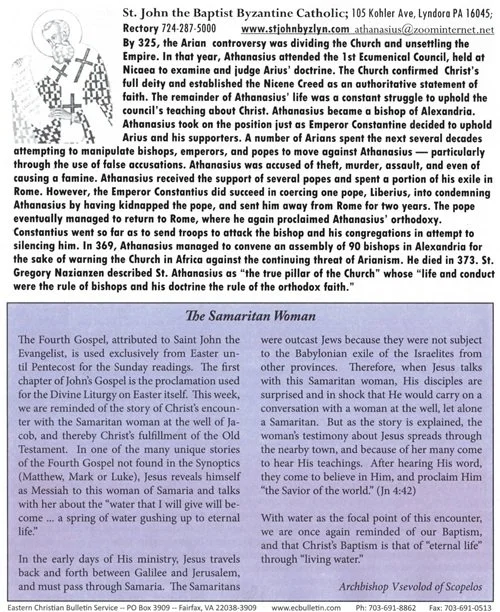
Sunday of the Samaritan Woman
Christ is Risen! Indeed He is Risen!
Samaritan Woman
May 3, 2026
Sat 5/2/26 4:00pm Vigil Divine Liturgy +Alec Olen by Cindy Hills
Sun 5/3/26 9:30am Liturgy +Michael Fizer (7th Anniversary of Passing) by Family
Wed 5/6/26 7:00pm Liturgy for Healing +Pauline Olen by Cindy Hills
Fri 5/8/26 7:00pm Resurrection Matins
Sat 5/9/26 4:00pm Vigil Divine Liturgy +Mary Cupps by Cindy Hills
Sun 5/10/26 9:30am Divine Liturgy +Karen Bohin by Andy Bohin & Family
Variable Parts: Sunday of the Samaritan Woman Festal Tone Pages 186 - 188
Epistle Acts 11:19-26 & 29-30
Gospel John 4:5-42
Memorial Candle Request: No Candle Request
Epistle Readers 2-May Mary Troyan 3-May Shari Allen 9-May John Baycura/Mary Motko 10-May Eva Bobick
Please Pray for: Erik Bergh, Mike Oshlick, Kathy Moyta, Dorothy Moyta, Brian Buchkovich, Lejen Warner, Sharon King, Ole J. Bergh, Liz Moyta, Fr. Michael Huszti, Fr. Laska, Susie Curcio, Teresa Milkovich, Robert Saper, Anna Habil, Mike Dancisin, Diane Sotak, Anna Pocchiari, Larry Hamil, Beverly Jones, Maryann Russin Schyvers, Nick Russin and Ken Konchan
Attendance: 4/25 —24 4/26 — 75; Collection: 4/25 & 4/26 $1,807.00
Student Food Pantry: May donations will be any canned food item, including Chef Boyardee items. Please consider donating to help with the summer months break. We will resume mid-August to help with the September back to school drive. Thank you for all donations Any questions, contact Pam Gagen.
Church History and 75th Anniversary video: During the presentation of our church history videos, there was interest from people to obtain a physical copy of it for themselves. If you are interested in getting a copy for yourself, please sign the sheet on the bulletin board in the basement indicating the format you'd prefer. The options for a physical copy would be either a DVD or USB drive. Once the level of interest is determined a price will be determined based on the cost of reproduction. This is only for people wanting a physical copy. The video will be made available online as well.
Ladies Guild: There will be a Ladies Guild meeting TODAY, May 3rd at 11:00 am in the church. Also, the Ladies Guild Spring Dinner will be Tuesday, May 12th at 6:00pm at Mamma Rosa restaurant.
Catechesis on prayer - 1. The mystery of prayer- Today we begin a new series of catecheses on the theme of prayer. Prayer is the breath of faith; it is its most proper expression. Like a cry that issues from the heart of those who believe and entrust themselves to God. Let us think about the story of Bartimaeus, a character in the Gospel (cf. Mk 10:46-52), and I confess that for me he is the most likeable of all. He was blind and sat begging for alms by the roadside on the periphery of his city, Jericho. He is not an anonymous character. He has a face and a name: Bartimaeus, that is, "son of Timaeus". One day he heard that Jesus would be passing through there. In fact, Jericho was a crossroads of people, continually criss-crossed by pilgrims and tradesmen. Thus, Bartimaeus positioned himself: he would have done anything possible to meet Jesus. So many people did the same. Let us recall Zacchaeus who climbed up the tree. Many wanted to see Jesus; he did too. In this way the man enters the Gospels as a voice that loudly cries out. He cannot see. He does not know whether Jesus is near or far away but he hears him. He understands this from the crowd which, at a certain point, grows and comes closer.... But he is completely alone and no one is concerned about him. And what does Bartimaeus do? He cries out. And he cries out and continues to cry out. He uses the only weapon he possesses: his voice.
He begins to shout: "Jesus, Son of David, have mercy on me!" (v. 47). And he continues to cry out in this manner. His repeated cries are a nuisance. They do not seem polite and many people scold him, telling him to be quiet: "But be polite; do not do this". However, Bartimaeus does not keep silent but rather cries out even more loudly: "Jesus, Son of David, have mercy on me!" (v. 47): That beautiful stubbornness of those who seek a grace and knock and knock on the door of God's heart. He cries out; he knocks. That expression: "Son of David", is very important. It means "the Messiah" — he professes the Messiah. It is a profession of faith that emerges from the mouth of that man who was despised by all. And Jesus listens to his cry. Bartimaeus' prayer touches his heart, God's heart, and the doors of salvation open up for him. Jesus calls for him. He jumps to his feet and those who had first told him to be quiet, now lead him to the Master. Jesus speaks to him. He asks him to express his desire — this is important — and then the cry becomes a request: "that I may see again, Lord!". Jesus says to him: "Go your way; your faith has made you well" (v. 52). He recognises in that poor, defenceless and despised man, all the power of his faith, which attracts the mercy and the power of God. Faith is having two hands raised up, a voice that cries out to implore the gift of salvation. The Catechism states that "humility is the foundation of prayer" (Catechism of the Catholic Church, 2559). Prayer is born of the earth, of the humus from which "humble", "humility" derive. It comes from our precarious state, from our continuous thirst for God (cf. ibid., 2560-2561). Faith, as we have seen with Bartimaeus, is a cry. Lack of faith is the suppression of that cry. That attitude that the people had, in making him keep quiet: they were not people of faith, whereas he was. To suppress that cry is a type of omerta (code of silence). Faith is a protest against a pitiful condition the cause of which we do not understand. Lack of faith is to limit ourselves to endure a situation to which we have become accustomed. Faith is the hope of being saved. Lack of faith is becoming accustomed to the evil that oppresses us and continuing in that way.
We begin this series of catecheses with Bartimaeus' cry because perhaps everything is already written in someone like him. Bartimaeus is a persevering man. He was surrounded by people who explained that imploring was useless, that it was clamouring without receiving a reply, that it was noise that was only bothersome, and thus please stop crying out. But he did not remain in silence. And in the end he obtained what he wanted. Greater than any discussion to the contrary, there is a voice in mankind's heart that invokes. We all have this voice within. A voice that comes forth spontaneously without anyone commanding it, a voice that asks itself about the meaning of our journey on earth, especially when we find ourselves in darkness: "Jesus, have mercy on me! Jesus have mercy on me!". This is a beautiful prayer.
These words are chiselled in all of creation. Everything invokes and implores so that the mystery of mercy may be definitively fulfilled. Not only Christians pray; they share their cry of prayer with all men and women. But the horizon can be further widened: Paul states that all of creation "has been groaning in travail together until now" (Rom 8:22). Artists are often the interpreters of this silent cry of creation that is found in every creature and emerges above all in the heart of men and women, because they are "beggars before God" (ccc, 2559). It is a beautiful definition of mankind: "beggars before God"; from this flows the mystery and necessity of prayer.
The Catholic Church on May 2 honors St. Athanasius of Alexandria, a bishop known as "the father of orthodoxy" for his dedication to the doctrine of Christ's divinity. Athanasius played a key role at the First Council of Nicaea in A.D. 325 and defended the Nicene Creed throughout his life. St. Athanasius was born to Christian parents living in the Egyptian city of Alexandria in 296. His parents took great care to have their son educated, and his talents came to the attention of a local priest who was later canonized St. Alexander of Alexandria. Around the age of 19, Athanasius spent a formative period in the Egyptian desert as a disciple of St. Anthony in his monastic community. Returning to Alexandria, he was ordained a deacon in 319 and resumed his assistance to Alexander, who had become a bishop. The Catholic Church, newly recognized by the Roman Empire, was encountering a new series of dangers from within. The most serious threat came from a priest named Arius, who taught that Jesus could not have existed eternally as God. Athanasius helped to prove that Jesus is True God and True man.