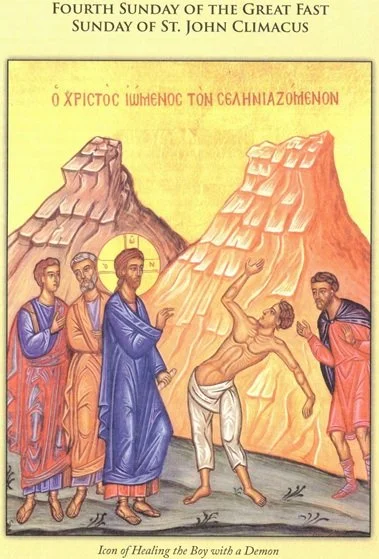
Fourth Sunday of the Great Fast Sunday of John Climacus
Glory to Jesus Christ! Glorify Forever!
Fourth Sunday of the Great Fast
March 15, 2026
Sat 3/14/26 4:00pm Vigil Divine Liturgy +Martha Sapar by Family
Sun 3/15/26 9:30am Divine Liturgy +Herbert and Margaret Moniot by Drew Moniot
Wed 3/18/26 7:00pm Liturgy of Pre-Sanctified Gifts
Fri 3/20/26 7:00pm Liturgy of Pre-Sanctified Gifts
Sat 3/21/26 4:00pm Vigil Divine Liturgy +In Memory of Prokopchak Family by Maria and Michael Streitman
Sun 3/22/26 9:30am Divine Liturgy +Judy Mawhinney by Scott & Becky Fizer
Variable Parts Tone 7 - Pages 156 - 158 4th Sunday of Great Fast — Pages 226— 227
Epistle Hebrews 6:13-20; Gospel Mark 9:17-31
Memorial Candle Request: No Candle Request
Epistle Readers 14-Mar John Baycura/Mary Motko 15-Mar Shari Allen 21-Mar Mary Troyan 22-Mar Eva Babick
Please Pray for: Mike Oshlick, Kathy Moyta, Dorothy Moyta, Brian Buchkovich, Lejen Warner, Sharon King, Ole J. Bergh, Liz Moyta, Fr. Michael Huszti, Fr. Laska, Susie Curcio, Teresa Milkovich, Robert Saper, Anna Habil, Mike Dancisin, Diane Sotak, Anna Pocchiari, Larry Hamil, Beverly Jones, Maryann Russin Schyvers; Nick Russin and Ken Konchan
Attendance: 3/4 - 28; 3/7 — 19; 3/8 —75; Collection: 3/7 & 3/8 - $2,641.00
Student Food Pantry: March's school donation drive is Mac N Cheese. Any questions, see Pam Gagen.
Upcoming Events: March 23rd — Jewish Seder dinner at 6:00pm. April 11th - Salad Bingo.
Paska Bread: We bake on March 26th and 27th. Paska Bread orders are restricted to parishioners. Order forms are on the bulletin board. Deadline for orders is March 15th. Please be sure to pick up your Paska order on the 28th. If unable to pick up, please pre-pay and your Paska will be put in the freezer.
Salad Bingo: Signup sheets for donations of prizes for the bingo are on the bulletin board. Donations from local businesses would also be appreciated. We need donations of salads for the bingo. Parishioners are asked to please donate at least one salad. These may be Jello, pasta, etc.
Youth Group Fundraiser: The St. John's teens will be selling milk chocolate Byzantine three-bar crosses as a fundraiser to support youth group programs and events. Crosses will be available for purchase after liturgies on March 15, 22, and 29. If you attend Saturday liturgy and would like to purchase crosses or would like to order 10 or more, please contact Amanda Stavish at 724-272-2963. The cost is $5 per chocolate cross. Thank you for supporting our youth group!
7th Catechesis on Discernment - Desolation Discernment is not primarily a logical procedure. It is based on actions, and actions also have an affective connotation, which should be acknowledged, because God speaks to the heart. Let us then turn to the first affective mode, an object of discernment: desolation. What does this mean? Desolation has been defined as follows: "Darkness of soul, disturbance in it, movement to things low and earthly, the unquiet of different agitations and temptations, ...when one finds oneself all lazy, tepid, sad and as if separated from his Creator and Lord" (Spiritual Exercises, 317). We have all experienced this., in one way or another, we have all experienced this desolation. The problem is how to interpret it, because it too has something important to tell us, and if we are in a hurry to free ourselves of it, we risk losing this. No one wants to be desolate, sad: this is true. We would all like a life that is always joyful, cheerful and fulfilled. Yet, in addition to not being possible — because it is not possible — this would also not be good for us. Indeed, the change from a life oriented towards vice can start from a situation of sadness, of remorse for what one has done. The etymology of this word, "remorse", is very beautiful: the remorse of the conscience, we all know this. Remorse: literally, it is the conscience that bites [in Italian, mordere], that gives no peace. Alessandro Manzoni, in The Betrothed, gave us a wonderful description of remorse as an opportunity to change one's life. It is the famous dialogue between Cardinal Federico Borromeo and the Unnamed, who, after a terrible night, turns up exhausted before the Cardinal, who addresses him with surprising words: "You have some good news for me; why do you hesitate to tell it?" "Good news?" says the other. "I have hell in my soul [...] Tell me, tell me, if you know, what good news could you expect from such a one as I". "That God has touched your heart, and is drawing you to himself' replied the Cardinal calmly" (Ch. 23). God touches the heart, and you feel something within: sadness, remorse for something, and it is an invitation to set out on a new path. The man of God knows how to notice in depth what moves in the heart.
It is important to learn how to read sadness. We all know what sadness is: all of us. But do we know how to interpret it? Do we know what it means for me, this sadness today? In our time, it — sadness — is mostly seen negatively, as an ill to avoid at all costs. Instead, it can be an indispensable alarm bell for life, inviting us to explore richer and more fertile landscapes, which transience and escapism do not permit. St Thomas defines sadness as a pain of the soul. Like the nerves for the body, it redirects our attention to a possible danger, or a disregarded benefit (Summa Theologica I-II, q. 36, a.1). This is why, it is indispensable for our health. It protects us from harming ourselves and others. It would be far more serious and dangerous not to feel this, and to go ahead. At times sadness works like a traffic light: "Stop, stop! It's red, here. Stop".
For those, on the other hand, who have the desire to do good, sadness is an obstacle with which the tempter tries to discourage us. In this case, one must act in a manner that is exactly contrary to what is suggested, determined to continue what one had set out to do (Spiritual Exercises, 318). Think of work, study, prayer, a commitment undertaken: if we abandoned them as soon as we felt boredom or sadness, we would never complete anything. This is also an experience common to the spiritual life: the road to goodness, the Gospel reminds us, is narrow and uphill, it requires combat, self-conquest. I begin to pray or dedicate myself to a good work, and strangely enough, just then, things come to mind that need to be done urgently — so as not to pray or do good works. We all experience this. It is important, for those who want to serve the Lord, not to be led astray by desolation and by this, "but no, I don't want to, this is boring..." — beware. Unfortunately, some people decide to abandon the life of prayer, or the choice they have made, marriage or religious life, driven by desolation, without first pausing to consider this state of mind, and especially without the help of a guide. A wise rule says not to make changes when you are desolate. It will be the time afterwards, rather than the mood of the moment, that will show the goodness or otherwise of our choices.
It is interesting to note, in the Gospel, that Jesus repels temptations with an attitude of firm resolution. Trials assail him from all sides, but always, finding in him this steadfastness, determined to do the will of the Father, they fail and cease to hinder his path. In spiritual life, trial is an important moment, as the Bible recalls explicitly, and says: "if you come forward to serve the Lord, prepare yourself for temptation" (Sir 2:1). If you want to take the good path, prepare yourself: there will be obstacles, there will be temptations, there will be moments of sadness. It is like when a professor quizzes a student. If he sees that the student knows the essentials of the subject, he does not insist: the student has passed the test. But he must pass the test.
If we know how to go through loneliness and desolation with openness and awareness, we can emerge strengthened in human and spiritual terms. No trial is beyond our reach; no trial will be greater than what we can do. But do not flee from trials: see what this test means, what it means that I am sad: why am I sad? What does it mean that in this moment I am in desolation? What does it mean that I am in desolation and cannot go on? St Paul reminds us that no one is tempted beyond his or her ability, because the Lord never abandons us and, with him close by, we can overcome any temptation. And if we do not overcome it today, we get up another time, we walk and we will overcome it tomorrow. But we must not remain dead — so to speak — we must not remain defeated by a moment of sadness, of desolation: go forward. May the Lord bless this courageous path of spiritual life, which is always a journey.