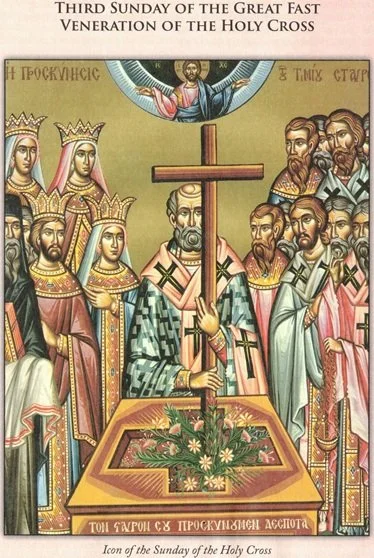
Third Sunday of the Great Fast Veneration of the Holy Cross
Glory to Jesus Christ! Glory Forever!
Third Sunday of the Great Fast
March 8, 2026
Sat 3/7/26 4:00pm Vigil Divine Liturgy +Paul and +Helen Macko Michalco by Rebecca Michalco
Sun 3/8/26 9:30am Divine Liturgy +Irene Simko (1 Year Anniversary of Passing) by David and Lisa Simko
Wed 3/11/26 7:00pm Liturgy of Pre-Sanctified Gifts +Bill
Fri 3/13/26 7:00pm Liturgy of Pre-Sanctified Gifts +Bill
Sat 3/14/26 9:30am 4th All Souls Saturday
Sat 3/14/26 4:00pm Vigil Divine Liturgy +Martha Sapar by Family
Sun 3/15/26 9:30am Divine Liturgy +Herbert and Margaret Moniot by Drew Moniot
Variable Parts Tone 6 - Pgs 152 — 153; 3rd Sunday of Great Fast — Pgs 223 - 225
Epistle Hebrews 4:14-5:6
Gospel mark 8:34-9:1
Memorial Candle Request: No Candle Request
Epistle Readers 7-Mar Mari Troyan 8-Mar Kathy Moyta 14-Mar John Baycura/Mary Motko 15-Mar Shari Allen
Please Pray for: Mike Oshlick, Kathy Moyta, Dorothy Moyta, Brian Buchkovich, Lejen Warner, Sharon King, Ole J. Bergh, Liz Moyta, Fr. Michael Huszti, Fr. Laska, Susie Curcio, Teresa Milkovich, Robert Saper, Anna Habil, Mike Dancisin, Diane Sotak, Anna Pocdiiari, Larry Hamil, Beverly Jones, Maryann Russin Schyvers, Nick Russin and Ken Konchan
Attendance: 2/25 —24; 2/28 —29; 3/1 —72; Collection 2/28 & 3/1 $2,196.00
Student Food Pantry: March's school donation drive is Mac N Cheese. Any questions, see Pam Gagen.
Upcoming Events:
Bible school - Tuesday -6:30pm
March 23rd — Jewish Seder dinner — starting at 6:00pm
April 11th — Salad Bingo.
Paska Bread: We are baking on March 26th and 27th. Paska Bread orders are restricted to parishioners. Order forms are on the bulletin board. Deadline for orders is March 15th. Please be sure to pick up your Paska order on the 28th. If unable to pick up, please pre-pay and your Paska order will be put in the freezer.
Salad Bingo: Signup sheets for donations of prizes for the bingo are on the bulletin board. Donations from local businesses would also be appreciated. We need donations of salads for the bingo. Parishioners are asked to please donate at least one salad. These may be Jello, pasta, etc.
Happy Birthday Eleanor Hills: Your parish wishes you a happy and healthy 11th year!
6. Catechesis on Discernment: "The book of one's own life" Knowing one's own life story is, let's say, an essential ingredient for discernment. Our life is the most precious "book" we have been given, a book that unfortunately many do not read, or rather they do so too late, before dying. And yet, precisely in that book, one finds what one pointlessly seeks elsewhere. Saint Augustine, a great seeker of the truth, had understood this just by rereading his life, noting in it the silent and discreet, but incisive, steps of the presence of the Lord. At the end of this journey, he noted with wonder: "You were within, and I without, and there I did seek you; I, unlovely, rushed heedlessly among the things of beauty you made. You were with me, but I was not with you" (Confessions X, 27.38). Hence his invitation to cultivate the inner life to find what one is seeking: "Return within yourself. In the inward man dwells truth" (On True Religion, XXXIX, 72). This is an invitation I would extend to all of you, and even to myself: "Return within yourself. Read your life. Read yourself within, how your journey has been... With serenity. Return within yourself'. Often, we too have had Augustine's experience, of finding ourselves imprisoned by thoughts that lead us away from ourselves, stereotypical messages that harm us: for example, "I am worthless" — and it gets you down; "everything goes wrong for me" — and it gets you down; "I will never achieve anything worthwhile" — and it gets you down, and that's life. These pessimistic phrases that get you down! Reading one's own history also means recognizing the presence of these "toxic" elements, but to then broaden our narrative, learning to notice other things, making it richer, more respectful of complexity, succeeding also in grasping the discreet ways in which God acts in our life. I once knew a person who people said deserved the Nobel Prize for negativity: everything was bad, everything, and he always tried to put himself down. He was a bitter person, and yet he had many qualities. And then this person found another person who helped him, and every time he complained about something, the other one would say: "But now, to compensate, say something good about yourself". And he would say: "Well, yes... I also have this quality", and bit by bit he helped him move forward, to read well his own life, both the bad things and the good things. We have to read our life, and thus see things that are not good and also the good things that God sows in us.
We have seen that discernment has a narrative approach; it does not dwell on the precise action, but rather inserts it into a context: where does this thought come from? What I am feeling now, where does it come from? Where does it lead me, what I am thinking now? When have I encountered it before? Is it something new that comes to mind only now, or have I found it other times? Why is it more insistent than others? What is life trying to tell me with this? Recounting the events of our life also enables us to grasp important nuances and details, which can reveal themselves to be valuable aids, hitherto concealed. For example, a reading, a service, an encounter, at first sight considered to be of little importance, over time transmit inner peace; they transmit the joy of living and suggest further good initiatives. Stopping and acknowledging this is essential. Stopping and acknowledging: it is important for discernment; it is a task of gathering those precious and hidden pearls that the Lord has scattered in our soil.
Goodness is hidden, always, because goodness is modest and hides itself: goodness is hidden; it is silent, it requires slow and continuous excavation. Because God's style is discreet: God likes to go unseen, with discretion, he does not impose himself; he is like the air we breathe — we do not see it but it allows us to live, and we realize this only when it is missing. Getting used to rereading one's own life educates the outlook, it sharpens it, enables it to note the small miracles that good God works for us every day. When we realize this, we notice other possible directions that strengthen our inner taste, peace and creativity. Above all, it makes us freer from toxic stereotypes. Wisely, it has been said that the man who does not know his own past is condemned to repeat it. It is strange: if we do not know the path we have taken, the past, we always repeat it, we go around in circles. A person who walks in circles never moves forward; there is no journey, it is like a dog who chases its own tail; always going this way and repeating things.
We might ask ourselves: have I ever recounted my life to anyone? This is a beautiful experience of engaged couples, who when they become serious, tell their life story... It is one of the most beautiful and intimate forms of communication, recounting one's own life. It allows us to discover hitherto unknown things, small and simple but, as the Gospel says, it is precisely from the little things that the great things are born (Lk 16: 10). The lives of the saints also constitute a precious aid in recognizing the style of God in one's own life: they permit us to become familiar with his way of acting. Some of the saints' behaviour challenges us, shows us new meanings and opportunities. This is what happened, for example, to Saint Ignatius of Loyola. When describing the fundamental discovery of his life, he adds an important clarification, and he says: From experience he deduced that some thoughts left him sad, others cheerful; and little by little he learnt to know the diversity of thoughts, the diversity of the spirits that stirred within him (cf. Autobiography, no. 8). Knowing what happens within us, knowing, being aware. Discernment is the narrative reading of the good moments and the dark moments, the consolations and desolations we experience in the course of our lives. In discernment, it is the heart that speaks to us about God, and we must learn to understand its language. Let us ask, at the end of the day, for example: what happened today in my heart? Some think that carrying out this examination of conscience is like doing the bookkeeping of the sins we have committed — and we commit many — but it is also about asking oneself, "What happened within me, did I experience joy? What brought me joy? Was I sad? What brought me sadness? And in this way, learning to discern what happens within us.