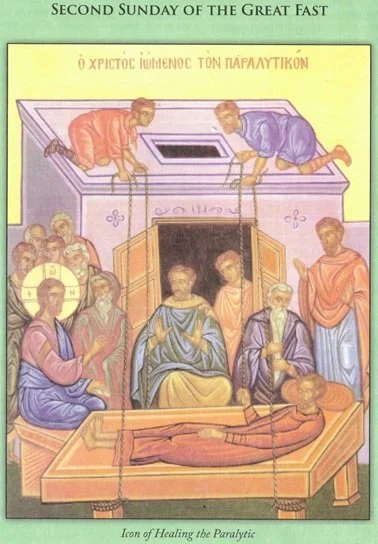
Second Sunday of the Great Fast
Glory to Jesus Christ! Glory Forever!
Second Sunday of the Great fast
March 1,2026
Sat 2/28/26 4:00pm Vigil Divine Liturgy +Stano & luba Protivnak (Health & Well Being) by Tina Soley
Sun 3/1/26 9:30am Divine Liturgy +Marilyn Book by Patty Nastasi
Wed 3/4/26 7:00pm Liturgy of Pre-Sanctified Gifts +Anna Hoszwa by Rick and Irene Reeder
Fri 3/6/26 7:00pm Liturgy of Pre-Sanctified Gifts
Sat 3/7/26 9:30am Divine Liturgy 3rd All Souls Saturday
Sat 3/7/26 4:00pm Vigil Divine Liturgy +Paul and +Helen Macko Michalco by Rebecca Michalco
Sun 3/8/26 9:30am Divine liturgy +Irene Simko (1 Year of Passing) by David and Lisa Simko
Variable Parts Tone 5 - Pgs 146 - 147 2nd Sunday of Great Fast — Pgs 222 - 223
Epistle: Hebrews 1:10-2:3;
Gospel: Mark 2:1-12
Antiphons During Lent: Regular Antiphons are replaced by the Typical psalms and Beatitudes found on pgs 16, 17, 23 in the green book.
Memorial Candle Request: +Irene Simko (1 Year Anniversary of Passing) by David and Lisa Simko
Epistle Readers 28-Feb John Baycura/Mary Motko 1-Mar Mike Dancisin 7-Mar Mary Troyan 8-Mar Kathy Moyta
Please Pray for: Mike Oshlick, Kathy Moyta, Dorothy Moyta, Brian Buchkovich, Lejen Warner, Sharon King, Ole J. Bergh, Liz Moyta, Fr. Michael Huszti, Fr. Laska, Susie Curcio, Teresa Milkovich, Robert Saper, Anna Habil, Mike Dancisin, Diane Sotak, Anna Pocchiari, Larry Hamil, Beverly Jones, Maryann Russin Schyvers, Nick Russin and Ken Konchan
Attendance: 2/18 — 30; 2/21 — 22; 2/22 — 82; Collection: 2/18 thru 2/22 $1,727.00
Student Food Pantry: March's school donation is Mac N Cheese.Any questions, contact Pam Gagen.
Upcoming Events:
March 23d — Jewish Seder dinner at 6:00pm.
April 1 — Salad Bingo.
April 25 and 26 - showing 2 movies about the church; each movie will be after the divine liturgy
Bible School: Meets Tuesday evenings at 6:30pm.
Paska Bread: We are baking on March 26th and 27th and pickup on March 28th. Paska Bread orders are restricted to parishioners. Order forms are on the bulletin board. The deadline for orders is March 15th.
Ladies Guild Meeting: There will be a Ladies Guild Meeting TODAY, March 1.
5. Catechesis on Discernment: The elements of discernment.
The desire: A Discernment is a form of searching, and searching always stems from something which we lack but which we somehow know — we have intuition. What kind of knowledge is this? Spiritual teachers refer to it using the term "desire", which, fundamentally, is a nostalgia for fullness that never finds complete fulfilment, and is the sign of God's presence in us. Desire is not the craving of the moment, no. The Italian word, [desiderio], comes from a very beautiful Latin term, this is curious: de-sidus, literally "lack of the star". Desire is the lack of the star, the lack of the reference point that orients the path of life; it evokes a suffering, a lack, and at the same time a tension to reach the good that we are missing. Desire, then, is the compass to understand where I am and where I am going; or rather, it is the compass to understand if I am still or if I am moving; a person who never desires is a static person, perhaps ill, almost dead. It is the compass to know if I am moving or if I am standing still. And how is it possible to recognize it? Let us think, a sincere desire knows how to deeply touch the chords of our being, which is why it is not extinguished in the face of difficulties or setbacks. It is like when we are thirsty: if we do not find something to drink, we do not give up; on the contrary, the yearning increasingly occupies our thoughts and actions, until we become willing to make any sacrifice in order to quench it — almost obsessed. Obstacles and failures do not stifle desire, no; on the contrary, they make it even more alive in us.
Unlike a momentary craving or emotion, desire lasts through time, even a long time, and tends to materialize. If, for example, a young person wishes to become a doctor, he or she will have to embark on a course of study and work that will occupy several years of his or her life, and consequently will have to set limits, say "no" first of all to other courses of study, but also to possible diversions and distractions, especially during the most intense periods of study. However, the desire to give his or her life a direction and to reach that goal — to become a doctor was the example — enables him or her to overcome these difficulties. Desire makes you strong, it makes you courageous, it makes you keep going forward, because you want to arrive at that: "I desire that". In effect, a value becomes beautiful and more easily achievable when it is attractive. As someone said, "more important than being good is having the desire to become good". Being good is Something attractive, we all want to be good, but do we have the wish to become good?
It is striking that before performing a miracle, Jesus often questions the person about his or her desire: "Do you want to be healed?". And at times this question seems out of place; it is clear that the person is sick! For example, when he meets the paralytic at the pool of Bethesda, who had been there for many years and had never managed to seize the right moment to get into the water, Jesus asks him: "Do you want to be healed?" (Jn 5:6). But how come? In reality, the paralytic's answer reveals a series of strange resistances to healing, which do not relate only to him. Jesus' question was an invitation to bring clarity to his heart, to welcome a possible leap forward: to no longer think of himself and his own life "as a paralytic", transported by others. But the man on the cot does not seem so convinced of this. By engaging in dialogue with the Lord, we learn to understand what we truly want from our life. This paralytic is the typical example of those who say, "Yes, yes, I want, I Want", but then, "I don't want, I don't want, I won't do anything". Wanting to do something becomes like an illusion and one does not take the step to do it. Those people who want and don't want. This is bad, and that sick man, there for 38 years but always grumbling: "No, you know, Lord, but you know when the waters move — that is the moment of the miracle — you know, someone stronger than me comes along, they enter, and I get there too late", and he complains and complains. But beware, because complaints are a poison, a poison to the soul, a poison to life, because they prevent the desire to go on from growing. Beware of complaints. When we complain in the family, married couples complain, one complains about the other, children about their father, or priests about the bishop, or bishops about many other things... No, if you find yourself grumbling, beware, it is almost a sin, because it keeps desire from growing.
Often it is precisely desire which makes the difference between a successful, coherent and lasting project, and the thousands of ambitions and good intentions with which, as they say, "hell is paved": "Yes, I would like, I would like, I would like...", but you do nothing. The era in which we live seems to promote maximum freedom of choice, but at the same time it atrophies desire — you want to be satisfied continually — which is mostly reduced to the desire of the moment. And we must be careful not to atrophy desire. We are bombarded by a thousand proposals, projects, possibilities, which risk distracting us and not permitting us to calmly evaluate what we really want. Many times, we find people — let's think about young people for example — with their phone in their hand, searching, looking... "But do you stop to think?" — "No". Always turned outwards, towards the other. Desire cannot grow in this way; you live in the moment, satiated in the moment, and desire does not grow. Many people suffer because they do not know what they want from their lives; they have probably never gotten in touch with their deepest desire, they have never known: "What do you want from your life?" — "I don't know". Hence the risk of passing one's existence between attempts and expedients of various kinds, never getting anywhere, and wasting precious opportunities. And so certain changes, though desired in theory, when the opportunity arises are never implemented; the strong desire to pursue something is lacking. If the Lord were to ask us, today, for example, any one of us, the question he asked the blind man in Jericho: "What do you want me to do for you?" (Mk 10:51) - let us think that the Lord today asks each one of us this: "What do you want me to do for you?" — how would we answer? Perhaps we could finally ask him to help us know His deepest desire, which God himself has placed in our heart: "Lord, may I know my desires, may I be a woman, a man of great desires". Perhaps the Lord will give us the strength to make it come true. It is an immense grace, the basis of all the others: to allow the Lord, as in the Gospel, to work miracles for us: "Give us desire and make it grow, Lord". Because he too has a great desire for us: to make us share in his fullness of life.