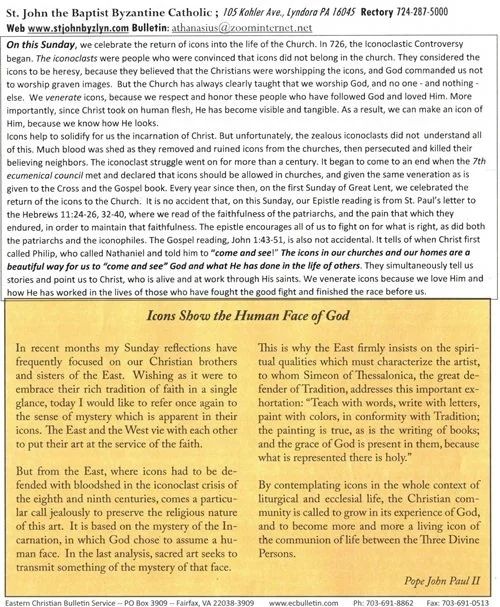
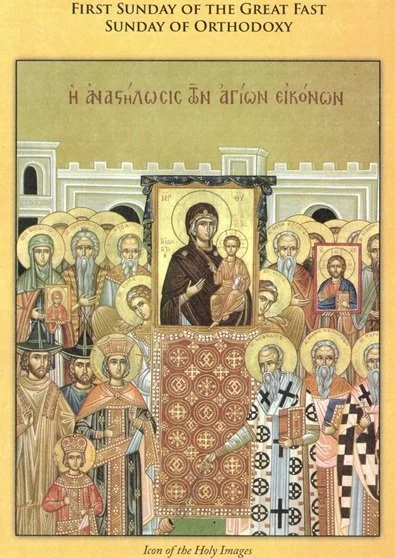
First Sunday of the Great Fast
Glory to Jesus Christ! Glory Forever!
First Sunday of the Great Fast
February 22, 2026
Sat 2/21/26 4:00pm Vigil Divine Liturgy +Members of Prokopchak Family by Maria and Michael Streitman
Sun 2/22/26 9:30am Divine Liturgy +Steve and +Mary Varva by Drew Moniot
Wed 2/25/26 7:00pm Liturgy of Pre-Sanctified Gifts
Fri 2/27/26 7:00pm Liturgy of Pre-Sanctified Gifts
Sat 2/28/26 9:30am 2nd All Souls Saturday
Sat 2/28/26 4:00pm Vigil Divine Liturgy +HWB Stano & Luba Protivnak by Tina Soley
Sun 3/1/26 9:30am Divine Liturgy +Marilyn Book by Patty Nastasi
Variable Parts Tone 4 - Pgs 141-142, Sunday of Great Fast — Pgs 220-222
Epistle Hebrews 11:24-26.32 - 12:2
Gospel John 1:43-51
Memorial Candle Request: No Candle Request
Epistle leaders 21-Feb Mary Troyan 22-Feb Amanda Stavish 28-Feb John Baycura/Mary Motko 1-Mar Mike Dancisin
Please Pray for: Mike Oshlick, Kathy Moyta, Dorothy Moyta, Brian Buchkovich, Lejen Warner, Sharon King, Ole J. Bergh, Liz Moyta, Fr. Michael Huszti, Fr. Laska, Susie Curcio, Teresa Milkovich, Robert Saper, Anna Habil, Mike Dancisin, Diane Sotak, Anna Pocchiari, Larry Hamil, Beverly Jones, Maryann Russin Schyvers, Nick Russin and Ken Konchan
Attendance: 2/14 — 23; 2/15 — 82; Collection: 2/14 & 2/15 $2,239.00
Student Food Pantry: February's school donation drive is any type of canned food. Any questions, please contact Pam Gagen.
Upcoming Events: March 23rd — Jewish Seder dinner — starting at 6:00pm April 11th - Salad Bingo. Bible School: Meets Tuesday evenings at 6:30pm.
Icon Class Full: Thank you for your interest in icon painting. My class filled up fast. If anyone remains interested still, I will place your name at the top of my list in my next class.... marynell14ayahoo.com
Paska Bread: We are baking Paska Bread on March 26th and 27th and pickup will be on March 28th. Paska Bread orders are restricted to parishioners. Order forms will be on the bulletin board next week. The deadline for orders is March 15th.
Attention Epistle Readers: Kathy Moyta has created a reader's schedule for the weekday Liturgies during Lent. This schedule will be placed on the epistle readers lectern. The Saturday/Sunday reader schedule is not affected by this and will continue uninterrupted.
4th Catechesis On Discernment: Self-knowledge - Knowing oneself is not easy. Indeed, discernment involves our human faculties: memory, intellect, will, affections. Often, we do not know how to discern because we do not know outselves well enough, and so we do not know what we really want. You have often heard: "But that person, why doesn't he sort out his life? He has never known what he wants...".
Underlying spiritual doubts and vocational crises, there is — not infrequently — insufficient dialogue between religious life and our human, cognitive and affective dimension. A writer on spirituality noted how many difficulties on the theme of discernment are indicative of problems of another kind, that should be recognized and explored. This author writes: "I have come to the conviction that the greatest obstacle to true discernment (and to real growth in prayer) is not the intangible nature of God, but the fact that we do not know ourselves sufficiently, and do not even want to know ourselves as we really are. Almost all of us hide behind a mask, not only in front of others, but also when we look in the mirror" (cf. Thomas H. Green, Weeds Among the Wheat, 1984). We all have the temptation to wear a mask, even in front of ourselves.
Forgetting God's presence in our life goes hand in hand with our ignorance of ourselves — ignoring God and ignoring ourselves — ignorance of our personality traits and of our deepest desires.
Knowing oneself is not difficult, but it is laborious: it entails patient soul-searching. It requires the capacity to stop, to "deactivate the autopilot", to acquire awareness of our way of acting, of the feelings that dwell within us, of the recurrent thoughts that condition us, and often unconsciously. It also requires that we distinguish between emotions and spiritual faculties. "I feel" is not the same as "I am convinced"; "I feel like" is not the same as "I want". Thus, we come to recognize that the view we have of ourselves and of reality is at times somewhat distorted. To realize this is a grace! Indeed, very often it can happen that erroneous convictions about reality, based on past experiences, strongly influence us, limiting our freedom to strive for what really matters in our lives.
Living in the computer age, we know how important it is to know passwords in order to get into programmes where the most personal and valuable information is stored. But spiritual life, too, has its "passwords": there are words that touch our heart because they make reference to what we are most sensitive to. The tempter, that is, the devil, knows these key words well, and it is important that we know them too, so as not to find ourselves where we do not want to be. Temptation does not necessarily suggest bad things, but often haphazard things, presented with excessive importance. In this way it hypnotizes us with the attraction that these things stir in us, things that are beautiful but illusory, that cannot deliver what they promise, and therefore leave us in the end with a sense of emptiness and sadness. That sense of emptiness and sadness is a sign that we have embarked on paths that were not right, that disoriented us. They can be, for example, degrees, careers, relationships, all things that are in themselves praiseworthy, but towards which, if we are not free, we risk harbouring unreal expectations, such as confirmation of our worth. For example, when you think of a study you are undertaking, do you think only of promoting yourself, of your own interests, or also to serve the community? There, one can see the intentionality of each one of us. The greatest suffering often comes from this misunderstanding because none of those things can be the guarantee of our dignity.
This is why it is important to know ourselves, to know the passwords of our heart, what we are most sensitive to, in order to protect ourselves from those who present themselves with persuasive words to manipulate us, but also to recognize what is truly important for us, distinguishing it from current fads or flashy, superficial slogans. Many times, what is said in a television programme, in some advertisement, touches our hearts and makes us go that way without freedom. Be careful about that: am I free, or do I let myself be swayed by the feelings of the moment, or the provocations of the moment?
An aid in this is an examination of conscience, but I am not talking about the examination of conscience that we all do when we go to confession, no. That is: "But I sinned in this, that...". No. A general examination of conscience of the day: what happened in my heart during this day? "Lots of things happened...". Which? Why? What traces did they leave in my heart? Carrying out an examination of conscience, that is, the good habit of calmly rereading what happened during our day, learning to note in our evaluations and choices what we give most importance to, what we are looking for and why, and what we eventually find. Above all, learning to recognize what satisfies my heart. What satisfies my heart? For only the Lord can give us confirmation of what we are worth. He tells us this every day from the cross: he died for us, to show us how precious we are in his eyes. There is no obstacle or failure that can prevent his tender embrace. The examination of conscience helps a great deal, because in this way we see that our heart is not a road where everything passes without us knowing about it. No. To see: what passed by today? What happened? What made me react? What made me sad? What made me joyful? What was bad, and did I harm others? It is about seeing the path our feelings took, the attractions in my heart during the day.
Don't forget! The other day we talked about prayer. Today we are talking about self-awareness. Prayer and self-knowledge enable us to grow in freedom. This is to grow In freedom! These are basic elements of Christian existence, precious elements for finding one's place in life.