26th Sunday After Pentecost
Glory to Jesus Christ! Glory Forever!
26th Sunday after Pentecost
December 7, 2025
Sat 12/6/25 4:00pm Vigil Divine Liturgy +John Prokopchak by Wife Jane
Sun 12/7/25 9:30am Divine Liturgy +John and +Doris Antoszyk by Mark Antoszyk
Mon 12/8/25 9:30am Maternity of Holy Anna Divine Liturgy +Martha Sapar by Family
Wed 12/10/25 7:00pm Liturgy for Healing +Souls in Purgatory by Marian Luther
Fri 12/12/25 9:30am Liturgy in memory of Our Lady of Guadalupe
Fri 12/12/25 7:00pm Moleben to Emmanuel
Sat 12/13/25 4:00pm Vigil Divine Liturgy +Gabe and +Irene Simko by Mary Ann Grechen
Sun 12/14/25 9:30am Divine Liturgy Sunday of the Forefathers John Donnelly by Cindy Hills
Variable Parts Tone 1 - Pages 125 - 127
Epistle Ephesians 5:9-19;
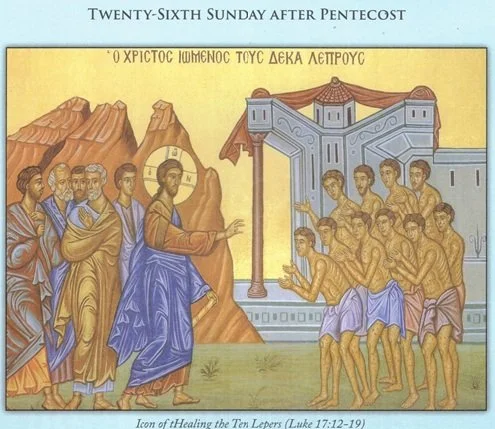
Gospel Luke 17:12-19
Memorial Candle Request: No Candle Request
Epistle Readers 6-Dec John Baycura/Mary Motko 7-Dec Hans Bergh 13-Dec Mary Troyan 14-Dec Mike Dancisin
Please Pray for: Mike Oshlick, Kathy Moyta, Dorothy Moyta, Brian Buchkovich, Lejen Warner, Sharon King, Ole J. Bergh, Liz Moyta, Fr. Michael Huszti, Fr. Laska, Susie Curcio, Teresa Milkovich, Robert Saper, Anna Habil, Mike Dancisin, Diane Sotak, Anna Pocchiari, Larry Hamil, Beverly Jones, Maryann Russin Schyvers, Nick Russin and Ken Konchan
Attendance: 11/29 — 26; 11/30am — 48; 11/30pm — 72; Collection: 11/29-11/30 - $2,043.00
Gibsonia schedule
Sun 12/7/25 11:30am Divine Liturgy 26th Sunday after Pentecost
Mon 12/8/25 6:00 pm Divine Liturgy
Thu 12/11/25 7:00pm Divine Liturgy
Student Food Pantry: For the month of December, we will be collecting cookies and treats associated with Christmas. Donations will be delivered before the kids are out of school for their Christmas break. Any questions, please contact Pam Gagen.
Church Decoration Assistance Needed: Help will be needed on December 16th at 2:00pm to decorate the church for Christmas.
Nut Roll Help Needed: we will be baking nut rolls December 12th. Please help if you are available. We will start at 8:00am.
Nut Roll Pickup: Pickup for nut rolls will be from 10:00am to 1:00pm on December 13th.
Christmas Caroling: We are scheduled to Christmas Carol, December 23rd at 6:30pm. We will be performing in the Concordia at Cabot Chapel, in the Haven II building, this year. The address is 148 Marwood Rd. Look for Entrance 5. It's the second to the last building on campus. Carolers should arrive by 6:15pm. We will do our best to arrange ride shares for those who wish to join us, who do not drive after dark. Please contact Shari Allen if you need a ride.
Jesse Tree: The Jesse tree helps us connect the custom of decorating Christmas trees to the events leading to Jesus' birth. We invite you to make an ornament for our parish Jesse tree based upon one of the twenty three symbols from the Old Testament. See Amanda Stavish for choices or call or text (724-2722963)! It can be a family event to make one or each of your children can make their own.. .it's up to you! Make the ornament with any medium that you choose. Ornaments will be placed on the tree on December 14th (Sunday of the Forefathers). Ornaments are due by Sunday. December 14th!
Thank You! Thank you to, everyone who donated desserts for the diaconate dinner, to the Ladies Guild for sponsoring the dinner, and to Rick Reeder for waxing the hall floor.
Table Sale: We will be selling the old tables that are in the Hall after the Theophany dinner, January 5th. They will be sold to parishioners $5.00 each. If you are interested, signup sheets are on the notice board.
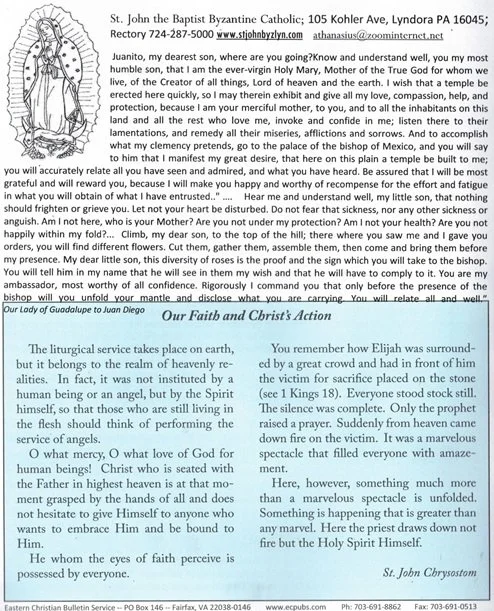
December 12th is the Feast Day of Our Lady of Guadalupe. Our Lady of Guadalupe first introduced herself as the Mother of God and the mother of all humanity when she appeared on the hill of Tepeyac in Mexico in 1531. An indigenous peasant, Juan Diego, saw a glowing figure on the hill. After she had identified herself to him, Our Lady asked that Juan build her a shrine in that same spot, in order for her to show and share her love and compassion with all those who believe. Afterwards, Juan Diego visited Juan de Zumarraga, who was Archbishop of what is now Mexico City. Zumarraga dismissed him in disbelief and asked that the future Saint provide proof of his story and proof of the Lady's identity. Juan Diego returned to the hill and encountered Our Lady again. The Virgin told him to climb to the top of the hill and pick some flowers to present to the Archbishop. Winter bloom. Although it was winter and nothing should have been in bloom, Juan Diego found an abundance of flowers of a type he had never seen before. The Virgin bundled the flowers into Juan's cloak, known as a tilma. When Juan Diego presented the tilma of exotic flowers to Zumarraga, the flowers fell out and he recognised them as Castilian roses, which are not found in Mexico. What was even more significant, however, was that the tilma had been miraculously imprinted with a colorful image of the Virgin herself.
1. Scientists have discovered that Mary's eyes possess the three effects of image refraction in a living eye. For over 20 years, a graduate in environmental systems engineering at Cornell University, Jose Tonsmann has studied the image of the Virgin left on the rough maguey-fiber fabric of Juan Diego's tilma. Though the dimensions are microscopic, the iris and the pupils of the image's eyes have imprinted on them a highly detailed picture of at least 13 people, including Bishop Zumarraga and St. Juan Diego. The same people are present in both the left and right eyes, in different proportions, as would happen when human eyes reflect the objects before them. Tonsmann said he believes the reflection transmitted by the eyes of the Virgin of Guadalupe is the scene on Dec. 9, 1531, during which Juan Diego showed his tilma, with the image, to Bishop Juan de Zumarraga and others present in the room. In his research, Tonsmann used a digital process used by satellites and space probes in transmitting visual information.
2. The image shows no sign of deterioration after nearly 500 years! The tilma or cloak of Juan Diego on which the image of Our Lady has been imprinted, is a coarse fabric made from the threads of the maguey cactus. This fiber disintegrates within 20-60 years. There is no under sketch, no sizing and no protective over-varnish on the image.
3. Microscopic examination revealed that there were no brush strokes. The image seems to increase in size and change colors due to an unknown property of the surface and substance of which it is made. According to Kodak of Mexico, the image is smooth and feels like a modern day photograph. (Produced 300 years before the invention of photography.) The tilma (an indigenous cape worn at the time of the apparition) is made of agave popotule fiber from the ixtle plant.
4. Studies have not succeeded in discovering the origin of the coloration of the Image. In 1979, Americans Philip Callahan and Jody B. Smith studied the image with infrared rays and discovered to their surprise that there was no trace of paint and that the fabric had not been treated with any kind of technique.
5. The stars on Our Lady's Mantle coincide with the constellation in the sky on December 12, 1531. All who have scientifically examined the image of Our Lady over the centuries confess that its properties are absolutely unique and so inexplicable in human terms that the image can only be supernatural!
6. In 1795, nitric acid was accidentally spilled on the left side of the Image. The acid did no significant damage, either to the Image or the fabric itself. There is a small distortion on the image where the acid spilled.