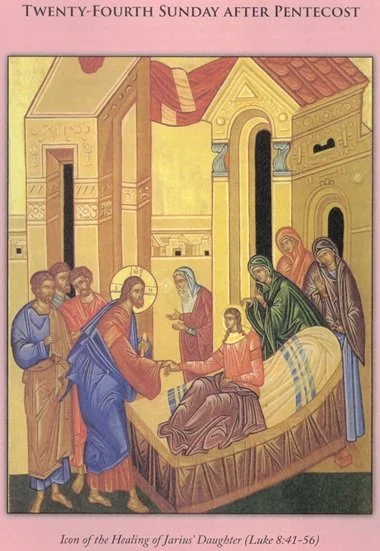
Glory to Jesus Christ! Glory Forever!
24th Sunday After Pentecost
November 8, 2026
St. John the Baptist Byzantine Catholic
105 Kohler Ave
Lyndora PA 16045
Phone 724-287-5000
www.stiohnbyzlyn.com
athanasius@zoominternet.net
Sat 11/7/26 4:00pm Vigil Divine Liturgy +Helen Jean Mudrick by brother Paul Mudrick
Sun 11/8/26 9:30am Divine Liturgy +Frank and Eva Dano by Peter & Jane Wallace
Fri 11/13/26 7:00pm Moleben to Emmanuel - preparation for Christmas
Sat 11/14/26 4:00pm Vigil Divine Liturgy +Helen Jean Mudrick by brother Paul Mudrick
Sun 11/15/26 9:30am Divine Liturgy +Karin Bohin By Andy Bohin and family
Variable Parts: Tone 7 - Pgs 156 —158 ; Archangel Michael — Pgs 265 — 266
Epistle: 2:14-22 & Heb 2:2-10
Gospel: Lk 8:41-56 & Lk 10:16-22
Memorial Candle Request: No Candle Request
Epistle Readers 7-Nov Mary Motko/John Baycura 8-Nov Eva Babick 14-Nov Mary Troyan 15-Nov Liz/John Pocchiari
Please Pray for: Lucas Benson, Lou Pocchiari, Mike Oshlick, Kathy Moyta, Dorothy Moyta, Brian Buchkovich, Lejen Warner, Sharon King, Liz Moyta, Fr. Michael Huszti, Fr. Laska, Susie Curcio, Teresa Milkovich, Robert Saper, Anna Habil, Diane Sotak, Anna Pocchiari, Larry Hamil, Beverly Jones, Maryann Russin Schyvers, Nick Russin and Ken Konchan
Attendance: 10/31 - 20; 11/1 - 83
Collection 10/31, 11/1 - $2216
Student Food Pantry: Thanksgiving is coming. We are now collecting Thanksgiving food items such as stuffing, gravy, yams, canned vegetables, etc. Donations may be placed in the designated area in the vestibule. Contact Pam Gagen if you have questions. Thank you!
Halupki Sale: The hulupki sale pickup will take place November 14th 10am -lpm. $3.00 a piece for previously placed orders.
St. Nicholas Celebration: Our St. Nicholas parish celebration will occur on December 5th. Divine Liturgy begins at 4:00pm followed with an ECF students' program. Catered dinner will be served in the Hall. You MUST sign up by November 29th if planning to attend.
Physical Help Needed: Men and women are needed Tuesday evening at 6:00pm to help move items back to the kitchen after it has been deep cleaned.
Nut, Poppyseed & Apricot Roll Orders: Orders are now being taken for nut, poppyseed and apricot rolls. Price per roll is $15.00. Pickup dates are December 12 or December 19. Orders will only be taken-through November 29. Please call 412-837-9446 or fill out an order form located on the bulletin board.
Upcoming Events Dates:
November 13 — Halupki Making
November 14 — Halupki Sale pickup
December 5 — St. Nicholas parish celebration
December 6 - Ladies Guild Christmas Party
December 10, 11 17 & 18 — Nut Roll Baking
December 16 — Decorate church for Christmas.
In Eastern Catholic theology, angels occupy a central, highly active, and deeply revered place. Often referred to as "the holy bodiless powers" (asomata), they are understood as real, intelligent, free-willed, spiritual beings created by God to serve His divine plan. Their role is described as:
1. Ceaseless Heavenly Worship- The primary and most fundamental role of the angels is to stand in the immediate presence of God, unceasingly offering praise and worship. Drawing from the visions of Isaiah (the Seraphim crying "Holy, Holy, Holy") and Ezekiel, Eastern theology views the angels as the perpetual choir of heaven, existing in a state of uncreated light and divine love.
2. Concelebrants in the Divine Liturgy - earthly worship is never a standalone human event; rather, it is an active participation in the heavenly liturgy. During the Divine Liturgy, we sings the Cherubic Hymn ("We who mystically represent the Cherubim..."), explicitly acknowledging that the invisible heavenly hosts are gathered around the altar alongside the human assembly. The priest or deacon quietly prays during the Liturgy that God will allow the angels to enter and concelebrate with the clergy, bringing down holiness upon the Eucharistic gifts.
3. Guardians and Intercessors for Humanity - we are supposed to maintain a deeply personal relationship with the angelic realm, particularly through the belief in our Guardian Angel.
a. The Guardian Angel: At Holy Baptism, every Christian is assigned a radiant guardian angel whose role is to protect the person from spiritual and physical harm, guide them toward righteousness, and defend them against demonic opposition.
b. Daily Prayer: Eastern prayer books feature specific morning and evening prayers addressed directly to one's guardian angel, asking for protection and forgiveness for daily failings.
c. At the Hour of Death: Tradition teaches that angels accompany the souls of the faithful at the moment of departure from the body, helping guide them through spiritual trials.
4. Messengers and Ministers of Salvation History - The word angelos (Etraoc) literally means "messenger." Throughout Scripture and Eastern theology, angels are the primary agents through whom God communicates His will and executes His interventions.
a. They announced the Incarnation (Archangel Gabriel to the TheotokosNirgin Mary).
b. They sang at Christ's Nativity and ministered to Him in the desert.
c. They were the first witnesses to announce the Resurrection.
5. Spiritual Warfare - angels are heavenly soldiers under the command of Archangel Michael (the "Captain of the Heavenly Hosts"). Angels actively battle against the dark, demonic forces of chaos and temptation, guarding the Church and shielding believers from spiritual ruin.
How Angels are Depicted in Eastern Churches: As Heavenly Warriors: Eastern iconography portrays angels as majestic, powerful, adult-male figures dressed in imperial or military garments, symbolizing their authority and role as soldiers of God.
On the Iconostasis (Icon Screen): The deacons' doors on the icon screen almost always feature icons of the Archangels Michael and Gabriel, symbolizing their role as attendants at the heavenly altar.
The Nine Orders: Eastern theology categorizes angels into nine traditional ranks (Seraphim, Cherubim, Thrones, Dominions, Powers, Authorities, Principalities, Archangels, and Angels).
The Church teaches that because angels do not possess physical bodies, they have no natural visual form that human eyes can see. When they appear in the Bible (such as to Abraham, Mary, or the shepherds), they must assume a temporary, visible form or manifest through spiritual vision. Therefore, the human-like shapes, wings, and robes seen in traditional icons are not literal portraits of what an angel looks like; Instead, they are symbolic theological language: Human form signifies their intelligence, personality, and capacity to relate to humans. Wings symbolize their swiftness, heavenly nature, and transcendence above earthly constraints. Maniacs (ribbons/stoles) and garments symbolize their status as messengers and ministers serving the divine liturgy of God.