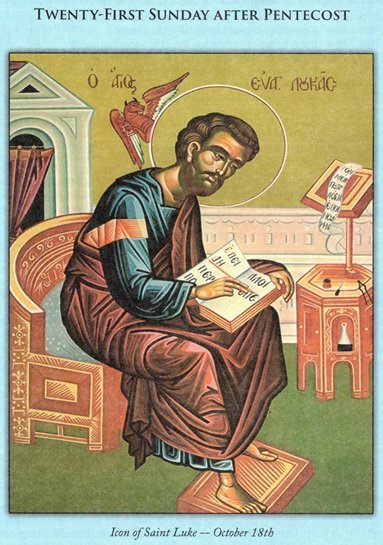
21st Sunday After Pentecost Holy Apostle and Evangelist Luke
Glory to Jesus Christ! Glory Forever!
21st Sunday After Pentecost
October 18, 2026
St. John the Baptist Byzantine Catholic
105 Kohler Ave
Lyndora PA 16045
Phone 724-287-5000
www.stiohnbyzlyn.com
athanasius@zoominternet.net
Sat 10/17/26 4:00pm Vigil Divine Liturgy +Richard Callihan by Matt and Darlene Callihan
Sun 10/18/26 9:30am Divine Liturgy +Karen Bohin by Andy Bohin & Family
Wed 10/21/26 7:00pm Liturgy +Helen Jean Mudrick by brother Paul Mudrick
Fri 10/23/26 7:00pm Akathist to the Theotokos
Sat 10/24/26 4:00pm Vigil Divine Liturgy +Ray Theodore by Richard Pribis
Sun 10/25/26 9:30am Divine Liturgy +Stanley Gawlikoski by Drew Monoit
Variable Parts: Tone 4 - Pgs 141 — 142
Epistle: Gal 2:16-20
Gospel: Lk 8:5-15
Memorial Candle Request: No Candle Request
Epistle Readers 17-Oct Mary Troyan 18-Oct Joel Hills 24-Oct Mary Motko/John Baycura 25-Oct Kathy Moyta
Memorial Candle Request: No Candle Request
Please Pray for: Lucas Benson, Lou Pocchiari, Mike Oshlick, Kathy Moyta, Dorothy Moyta, Brian Buchkovich, Lejen Warner, Sharon King, Liz Moyta, Fr. Michael Huszti, Fr. Laska, Susie Curcio, Teresa Milkovich, Robert Saper, Anna Habil, Diane Sotak, Anna Pocchiari, Larry Hamil, Beverly Jones, Maryann Russin Schyvers, Nick Russin and Ken Konchan
Attendance: 10/10 - 23; 10/11 - 85
Collection 10/10, 10/11 - $1866
Student Food Pantry: Thanksgiving is coming. We are now collecting Thanksgiving food items such as stuffing, gravy, yams, canned vegetables, etc. Donations may be placed in the designated area in the vestibule. Contact Pam Gagen if you have questions. Thank you!
Boscov Coupons: Our church will be selling Boscov coupons for a 25% off all day October 21. Coupons are $5.00. Please see Elizabeth Pocchiari or Fr. Radko to purchase one.
Rummage Sale Follow-ups The winner of the 50/50 at the Rummage Sale was Gloria Rodgers, who won $124.00. We had a steady stream of customers and made a $2,928.75 profit, which includes the GCU matching funds. Many thanks to our Ladies Guild and volunteers for making this possible.
Operation Christmas Child: Please continue to send in your donations for the Operation Christmas Child program by October 25ffi. Thank you to those who have already generously donated. The box is in the vestibule. Please check out this website for suggestions on what is helpful to donate or ask Amanda Stavish. If you would prefer to give a cash donation, this is also very welcome! Amanda will purchase needed items with your donation. Thank you!
REC Open House: (The Religious Education Center) Open House will be on November 1. 2026 immediately following the 9:30 Liturgy. Father will bless the center. Coffee social will take place at the RE Center this day. Coffee, cider, donuts and danishes will be served. (THERE WILL BE NO SOCIAL COFFEE TAKING PLACE IN THE CHURCH HALL ON THIS DAY). The church council is excited and looking forward to seeing everyone there.
Upcoming Events Dates:
October 26 — Parish Council Meeting at 6:00pm.
November 1 — Ladies Guild meeting at 11:00am in the church.
November 13 — Halupki Making
November 14 — Halupki Sale.
December 5 — St. Nicholas parish celebration
December 6 - Ladies Guild Christmas Party
December 10, 11 17 & 18 — Nut Roll Baking
December 16 — Decorate church for Christmas.
Homemade Halupki!
St. John the Baptist Byzantine Church
105 Kohler Avenue
Lyndora, PA
$3.00 Each
Pickup Saturday November 14
10am - 1pm at the church
To order call (412) 857-9446
BEFORE November 1
Pre-orders only, NO walk-Ins
(Please do not call the church or rectory)
Saint & Martyr, Pope Callistus I: 16th pope, died about 222. The only story of his life we have is from someone who hated him and what he stood for, an author identified as Saint Hippolytus, a rival candidate for the chair of Peter. What had made St. Hippolytus so angry? St. Hippolytus was very strict and rigid in his adherence to rules and regulations. The early Church had been very rough on those who committed sins of adultery, murder, and fornication. St. Hippolytus was enraged by the mercy that pope Callistus showed to these repentant sinners, allowing them back into communion of the Church after they had performed public penance. Callistus' mercy was also matched by his desire for equality among Church members, manifested by his acceptance of marraiges between free people and slaves. Hippolytus saw all of this as a degradation of the Church, a submission to lust and licentiousness that reflected not mercy and holiness in St. Callistus but perversion and fraud. Pope Callistus is also well know for the greatest catacombs in Rome.
Trying to weed out the venom to find the facts of Callistus' life in Hippolytus' account, we learn that Callistus himself was a slave. His master, Carporphorus made him manager of a bank in the Publica Piscina sector of Rome where Callistus took in the money of other Christians. The bank failed -- according to Hippolytus because Callistus spent the money on his own pleasure-seeking. It seems unlikely that Carporphorus would trust his good name and his fellow Christians' savings to someone that unreliable.
Whatever the reason, Callistus fled the city by ship in order to escape punishment. When his master caught up with him, Callistus jumped into the sea (according to Hippolytus, in order to commit suicide). After Callistus was rescued he was brought back to Rome, put on trial, and sentenced to a cruel punishment -- forced labor on the treadmill. Carporphorus took pity on his former slave and manager and Callistus won his release by convincing him he could get some of the money back from investors. (This seems to indicate, in spite of Hippolytus' statements, that the money was not squandered but lent or invested unwisely.) Callistus' methods had not improved with desperation and when he disrupted a synagogue by shouting for money, he was arrested and sentenced again. This time he was sent to the mines. Other Christians who had been sentenced there because of their religion were released by negotiations between the emperor and Pope. Callistus accidentally wound up on the same list with the persecuted brothers and sisters. Apparently, everyone, including the Pope, realized Callistus did not deserve his new freedom but unwilling to carry the case further the Pope gave Callistus an income and situation -- away from Rome. (Once again, this is a point for suspecting Hippolytus' account. If Callistus was so despicable and untrustworthy why provide him with an income and a situation?.) About 9-10 years later, the new pope Zephyrinus recalled Callistus to Rome. Zephyrinus was good-hearted and well-meaning but had no understanding of theology. This was disastrous in a time when heretical beliefs were springing up everywhere. Callistus soon made his value known, guiding Zephyrinus through theology to what he saw as orthodoxy. When Zephyrinus died in 219, Callistus was proclaimed pope over the protests of his rival candidate Hippolytus. Callistus came to power during a crucial time of the Church. Was the church going to hang on to the rigid rules of previous years and limit itself to those who were already saints or was it going to embrace sinners as Christ commanded? We can understand Hippolytus' fear - that hypocritical penitents would use the Church and weaken it in the time when they faced persecution. But Callistus chose to trust God's mercy and love and opened the doors. Pope Callistus is listed as a martyr but we have no record of how he was martyred or by whom. There were no official persecutions at the time, but he may well have been killed in riots against Christians. As sad as it is to realize that the only story we have of his life is by an enemy, it is glorious to see in it the fact that the Church is large enough not only to embrace sinners and saints, but to proclaim two people saints who hold such wildly opposing views (St. Hippolitus and St Callistus) and to elect a slave and an alleged ex-convict to guide the whole Church. There's hope for all of us then!