19thSunday After the Pentecost
Glory to Jesus Christ! Glory Forever!
19th Sunday After Pentecost
October 4, 2026
St. John the Baptist Byzantine Catholic
105 Kohler Ave
Lyndora PA 16045
Phone 724-287-5000
www.stiohnbyzlyn.com
athanasius@zoominternet.net
Sat 10/3/26 4:00pm Vigil Divine Liturgy +Emma Jean Buchovich by Kevin and Shari Allen
Sun 10/4/26 9:30am Divine Liturgy +John Kavchak by Drew Moniot
Fri 10/9/26 7:00pm Akathist to Mary
Sat 10/10/26 4:00pm Vigil Divine Liturgy +Michael Dancisin by John Baycura
Sun 10/11/26 9:30am Divine Liturgy +Marilyn Book by Fizer Family
Variable Parts: Tone 2 - Pgs 130 - 131
Epistle: 2 Cor 11:31-12:9
Gospel: Lk 8:5-15
Memorial Candle Request: No Candle Request
Epistle Readers 3-Oct Mary Troyan 4-Oct Liz/John Pocchiari 9-Oct John Baycura/Mary Motko 11-Oct Amanda Stavish
Memorial Candle Request: No Candle Request
Please Pray for: Lucas Benson, Lou Pocchiari, Mike Oshlick, Kathy Moyta, Dorothy Moyta, Brian Buchkovich, Lejen Warner, Sharon King, Liz Moyta, Fr. Michael Huszti, Fr. Laska, Susie Curcio, Teresa Milkovich, Robert Saper, Anna Habil, Diane Sotak, Anna Pocchiari, Larry Hamil, Beverly Jones, Maryann Russin Schyvers, Nick Russin and Ken Konchan
Attendance: 9/27 - 81; 9/30 - 15 10/1 - 6
Helen Jean Mudrick: Our parish wishes to thank Paul Mudrick, brother of recently deceased Helen Mudrick, for donating $1,000.00 in memory of his sister. A series of Liturgies will be offered for Helen.
Randall "Randy" L. Burns, age 66, father of Derek Burns, passed away peacefully on Sept 24 May The Almighty Lord grant him peaceful repose and Eternal Memory Vicnaja Pamjat
Ladies Guild: There is a Ladies Guild meeting TODAY at 11:00am in the church.
Student Food Pantry: The school year is beginning. We are collecting food again for the pantry at a local school. If you would donate any type of soup or canned food, baskets will be in the church. Thank you! - Pam Gagen.
Rummage Sale: The Rummage Sale is this Friday (9:00am — 2:00pm) and Saturday (9:00am — I:00pm). On Friday we will be selling halushki and kielbasa. On Saturday most items will be half price. After the Saturday and Sunday Liturgy, you may take what you want for a donation. Please, no more Rummage Sale donations after Wednesday. Help will be needed on Sunday to pack everything up, thank you. The final drawing for the 50/50 will be drawn at the coffee social.
Boscov Coupons: Our church will be selling Boscov coupons for a 25% off all day October 21. Coupons are $5.00. Please see Elizabeth Pocchiar or Fr. Radko to purchase one.
Operation Christmas Child: Please continue to send in your donations for the Operation Christmas Child program by October 256. Thank you to those who have already'generously donated. The box is in the vestibule. Please check out the website for suggestions on what is helpful to donate or ask Amanda Stavish. If you would prefer to give a cash donation, this is also very welcome! Amanda will purchase needed items with your donation. Thank you!
ADDRESS OF POPE LEO XIV Shrine of Our Lady of Lourdes Sunday, 27 September 2026
We are gathered this evening to respond to the request that Our Lady addressed to the priests through Saint Bernadette: "People should come here in procession." How moving it is to see the faithful, from one generation to the next, respond with love and trust to the tender invitation of the Virgin Mary. How consoling it is to hear Christians sing hymns filled with fervor and faith, and to see them walk, with a light in their hands, towards their Mother in Heaven, the Mother whom Jesus gave us from the Cross. I give thanks to the Lord that I, too, may respond this evening to the call of our Mother, becoming a pilgrim among pilgrims.
The light that guides us and draws us onward is the light of hope, which never abandons us even as we journey through this life — a life often marked by trials, yet already filled with the joy of knowing ourselves to be children of God, loved and saved by Jesus. Those who are sick are privileged witnesses to this transfiguration of our lives through faith and love of God and neighbor. It is indeed necessary to come here and take part in this procession with you, dear brothers and sisters who are ill, in order to experience this full reality As Pope Pius XII wrote: "No one has ever seen such a procession of suffering in one spot on earth, never such radiance of peace, serenity, and joy" (Pius XII, Encyclical Letter, 1957).
If such a miracle is possible — the miracle of finding serenity and joy amidst suffering — it is because God grants us the grace to perceive the life-giving presence of the risen Christ among us. He enables us to look beyond our earthly horizon towards a more distant future, a future of immeasurable happiness in God, which we are assured of attaining if we remain steadfast in faith and charity. For this reason, Saint Paul encourages us: "The sufferings of this present time are not worth comparing with the glory about to be revealed to us" (Rom 8:18). Dear brothers and sisters who are ill, keep these precious words constantly in your hearts: The sufferings of this present time are not worth comparing with the glory about to be revealed to us.
We are therefore called always to persevere on our journey, with Mary going before us, for as many days as are granted to us in this life. We hasten with confidence towards her, whose Immaculate Conception shines like a beacon in the night. "She is thus the sign of the victory of love, of good and of God, giving our world the hope that it needs. This evening, let us turn our gaze towards Mary, so glorious and so human, allowing her to lead us towards God who is the victor" (Benedict XVI, Homily, 2008).
"I am the Immaculate Conception." This is how Mary identified herself here, with the greatest humility, while giving thanks to God for the unique privilege bestowed upon her — a privilege that for us represents the dawn of salvation. By the merits of his passion and resurrection, Jesus willed to preserve his Mother from every trace of original sin. He made her a new Eve, over whom the devil would never have any power. From her, everything begins anew, everything becomes possible once more, both for the world and for each one of us. This is why her support and intercession are vital for Christians who wish to receive the grace of redemption won for us through Jesus' blood and to resist evil. She is the Star of the Sea — Stella Maris — who comes to our aid in times of tribulation. As Saint Bernard expressed so beautifully: "O you who find yourself tossed about by the storms of life, turn not your eyes from the brightness of this Star, if you would not be overwhelmed by its boisterous waves... Following her, you will never go astray; when you implore her aid, you will never yield to despair; thinking on her, you will not err; under her patronage you will never wander; beneath her protection you will not fear; she being your guide, you will not weary; if she be your propitious Star, you will arrive safely into har1bor" (Saint Bernard, On the "Missus Est", Homily II).
Dear brothers and sisters, pilgrims and all who are ill, you have come from France and throughout the world to take part in this fervent and peaceful procession of light. Let us bring our dearest and most urgent intentions, and present them to Our Lady. As we contemplate her in her Immaculate Conception, may joy and invincible hope rise within our hearts. Clothed with the sun, with the moon beneath her feet and crowned with stars, she is glorious and powerful; yet she is also humble and very close to us. She is the Mother of Jesus, and she is our Mother. O Immaculate Virgin, may this light that we hold this evening never be extinguished in our lives, but may it illuminate the future, opening us even today to the promises of eternal life..
Lourdes- apparation in Lourdes, France 1858
Massabielle, 11 February 1858: the first apparition: On 11 February 1858, while gathering firewood near the Gave de Pau, fourteen-year-old Bernadette Soubirous saw, in the grotto of Massabielle, a young Lady who invited her to pray the rosary. That day, Bernadette had gone to collect wood with her sister Toinette and a friend, along the Gave de Pau, the river that runs through Lourdes. In front of the grotto of Massabielle — a name meaning "old rock" in the local Bigourdan dialect — she heard a sound and saw, in a hollow of the rock, a young woman dressed in white. At first, Bernadette did not know whom she was seeing. In her depositions, gathered during the 1858 inquiry, she referred to the vision with a cautious word from her dialect: Aquero, meaning "that" (Rene Laurentin, Vie de Bernadette, p. 56). She then took up her rosary — the prayer that tells dozens of Ave Marias —and the Lady let her pray in silence. This first encounter set the tone for all the others. The Lady did not impose herself, did not yet name herself, and chose as her witness a poor, uneducated child. To learn more about the visionary herself, you may read the life of Saint Bernadette Soubirous.
The course of the 18 apparitions: the fortnight and the spring:
The eighteen apparitions unfolded over five months, from 11 February to 16 July 1858. Between 18 February and 4 March, the Lady asked Bernadette to come for fifteen days in a row: the "fortnight".
After 11 February, Bernadette returned to the grotto. On 18 February, at the third apparition, the Lady spoke to her for the first time and asked her to come back for fifteen days (Laurentin, Recit, p. 251). During this period, known as the fortnight, the crowd around the grotto grew day by day, while Bernadette kept coming to pray. Not all the apparitions were alike. Some were silent; in others, the Lady spoke and entrusted requests. The available sources do not allow us to reconstruct an identical account for each of the eighteen days, so we keep here to the best-established milestones.
The spring of 25 February (ninth apparition)
The 25th of March was not the only significant day. On 25 February, at the ninth apparition, the Lady asked Bernadette to drink at the spring and to wash there. As no spring was visible, Bernadette scratched at the earth on the floor of the grotto; little by little, water began to flow from the mud (Sanctuary of Our Lady of Lourdes). This is the origin of the spring water of Lourdes, at which pilgrims today are invited to make the water gesture. One point must be precise: this is a gesture of faith, and its value is spiritual and sacramental, not medical. What this gesture represents is developed on the page devoted to the spring water of Lourdes.
The message entrusted to Bernadette: prayer, penance, conversion
The message of Lourdes rests on three words: prayer, penance and conversion. The Lady asked Bernadette to pray for sinners and repeated this call to penance.
Through the successive encounters, the Lady entrusted a simple message, one that aims first at the heart. She asked for prayer and penance, summing everything up in these words reported by Bernadette: "Penance! Penance! Penance! Pray to God for sinners" (Sanctuary of Our Lady of Lourdes).
The word "penance" can be misunderstood. The Sanctuary of Lourdes clarifies its meaning: by penance, one should understand above all conversion, that is, turning one's heart towards God and towards others. The Lady also asked that people come in procession to the grotto and that a chapel be built there.
This message was not reserved for Bernadette alone. Through her, it is addressed to all who come to pray at Lourdes. That is why it has crossed the generations without losing any of its simplicity.
"Que soy era Immaculada Councepciou": the name of the Lady
On 25 March 1858, at the sixteenth apparition, the Lady finally revealed her name. She said it in Bernadette's dialect: Que soy era lmmaculada Councepciou — [I am the Immaculate Conception — Pyrenean Gascon, 25 March 1858].For weeks, Bernadette had been asking the Lady for her name, without reply. On 25 March, the feast of the Annunciation, the Lady answered at last. Bernadette repeated the phrase without understanding it, all the way to the parish priest of Lourdes, so as not to forget it (Laurentin, Recit). The fact that an uneducated child reported a theological formula she did not grasp was taken, at the time, as a sign in favour of the apparitions' authenticity.
The phrase points to a truth of faith proclaimed shortly before. On 8 December 1854, through the bull Ineffabilis Deus, Pope Pius IX had defined the dogma of the Immaculate Conception: Mary was preserved from original sin from the moment of her conception (CCC § 491). The CCC is the Catechism of the Catholic Church, the reference text of doctrine. A frequent confusion must be avoided. The Immaculate Conception concerns the conception of Mary, not the virginal conception of Jesus: these are two distinct truths (CCC § 490-493). The link between the dogma of 1854 and the name given at Lourdes in 1858 deeply impressed contemporaries.
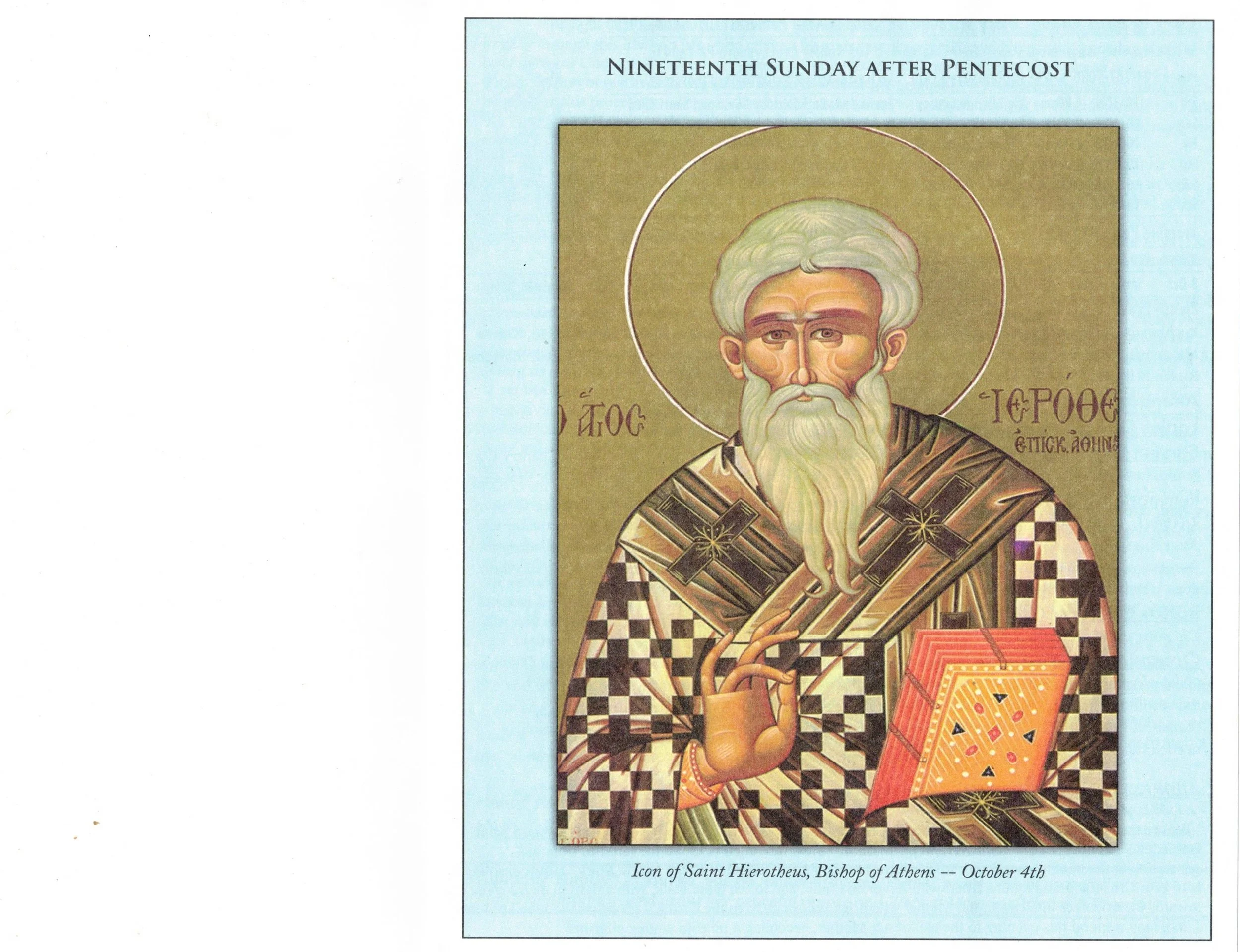
Saint of the week: Hieromartyr Hierotheus (often referred to as Saint Hierotheus of Athens or Hierotheus the Thesmothete) is an early Christian saint, bishop, and martyr who lived in the 1st century. He is especially revered in the Eastern Orthodox, Roman Catholic, and other apostolic traditions.
1. Background and Conversion
The Areopagus: Hierotheus was originally a member of the Athenian Areopagus (the high court and council of ancient Athens). Along with his contemporary Saint Dionysius the Areopagite, Hierotheus was converted to Christianity by the Apostle Paul during Paul's famous visit to Athens around the middle of the 1st century.
Episcopacy: Tradition notes that he was consecrated as the first Bishop of Athens by the Apostle Paul (though some historical traditions occasionally interchange or group this distinction closely with Dionysius).
2. Presence at the Dormition of the Theotokos
According to sacred Church tradition, Hierotheus played a unique role during the Dormition (the falling asleep/passing) of the Most Holy Theotokos (the Virgin Mary). Along with several Apostles and Saint Dionysius, Hierotheus miraculously traveled to Jerusalem to attend her burial. Tradition records that he chanted hymns during the funeral procession with such profound, heavenly beauty that those gathered were deeply moved by his mystical understanding of divine things.
3. Martyrdom and Feast Day
Title "Hieromartyr": In Christian terminology, a hieromartyr is a saint who was both a member of the clergy (bishop or priest) and died a martyr for the faith. Hierotheus sealed his ministry by suffering a martyr's death later in the 1st century under Roman persecution. Feast Day: His memory is celebrated annually on October 4th (in churches following the traditional calendar).
4. Legacy in Christian Mysticism
Later in Christian history (around the 5th or 6th century), the anonymous mystical writer known as Pseudo-Dionysius the Areopagite frequently referenced Hierotheus as his mentor and teacher in divine matters, describing him as a man rapt in divine love and profoundly experienced in the mystical theology of God.