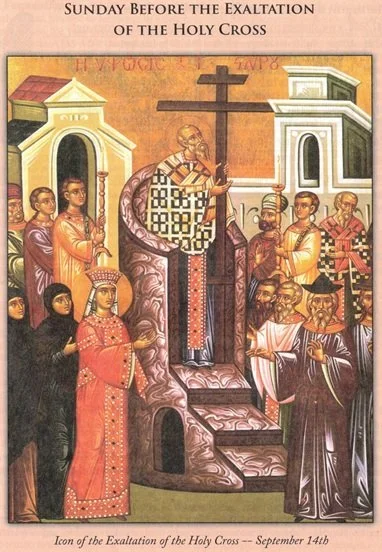
Sunday Before the Exultation of the Holy Cross
Glory to Jesus Christ! Glory Forever!
15th Sunday after Pentecost
September 6, 2026
St. John the Baptist Byzantine Catholic
105 Kohler Ave
Lyndora PA 16045
Phone 724-287-5000
www.stiohnbyzlyn.com
athanasius@zoominternet.net
Sat 9/12/26 4:00pm Vigil Divine Liturgy +Michael Dancisin by John Baycura
Sun 9/13/26 9:30am Divine Liturgy +Herbert & Margaret Moniot by Drew Moniot
Mon 9/14/26 9:30am Divine Liturgy of Exaltation of the H. Cross +Helen Dimun by Pocchiari Family
Wed 9/16/26 7:00pm Liturgy for Healing
Fri 9/18/26 7:00pm Moleben to Jesus Christ
Sat 9/19/26 4:00pm Vigil Divine Liturgy Vigil Divine Liturgy +Michael Dancisin by Bob and Betsy Sychak
Sun 9/20/26 9:30am Divine Liturgy +Wasyl Hoszwa by Rick and Irena Reeder
Variable Parts: Tone 7 - Pgs 156 —158;
Epistle: Gal 2 :16-20;
Gospel: Mk 8:34-9:1
Memorial Candle Request: No Candle Request
Epistle Readers 12-Sep John Baycura/Mary Motko 13-Sep Kathy Moyta 19-Sep Mary Troyan 20-Sep Shari Allen
Memorial Candle Request: No Candle Request
Please Pray for: Lucas Benson, Lou Pocchiari, Mike Oshlick, Kathy Moyta, Dorothy Moyta, Brian Buchkovich, Lejen Warner, Sharon King, Liz Moyta, Fr. Michael Huszti, Fr. Laska, Susie Curcio, Teresa Milkovich, Robert Saper, Anna Habil, Diane Sotak, Anna Pocchiari, Larry Hamil, Beverly Jones, Maryann Russin Schyvers, Nick Russin and Ken Konchan
Attendance: 9/5 - 26 9/6 - 62 8/30 - 71
Collection: 9/5 - 9/6: $2,419.00
Gibsonia Schedule
Sun 9/13/26 11:30am Divine Liturgy Sunday Before the Exaltation
Mon 9/14/26 7:00pm Divine Liturgy
Thu 9/17/26 7:00pm Divine Liturgy
Upcoming Event Dates:
September 15th - Ladies Guild Meeting at 6:00pm — Yearly dues are $5.00
October 9th and 10th - Rummage Sale
Student Food Pantry: The school year is beginning. We are collecting food again for the pantry at a local school. If you would donate any type of soup or canned food, baskets will be in the church. Thank you! -Pam Gagen.
Help Us Renew Our Religious Education Building! Please help us fund the flooring for the R.E. building. Details regarding this are in the 8/16/26 and 8/23/26 bulletins.
Religious Education: Sunday, September 27 following social coffee will be the Religious Education Kickoff party at Connoquenessing Park. This will include the rescheduled, annual fishing derby and other games! All are invited! Religious Education Classes for grades 1-12 will officially begin on October 4. Please sign up with Amanda Stavish 724-272-2963 or Katie Koch.
Rummage Sale: Donations for the Rummage Sale may be brought to the church starting the weekend of September 19/20. No clothing. Please make sure your items are clean, usable, and in working condition.
Boscov Coupons: Our church will be selling Boscov coupons for a 25% off all day October 21. Coupons are $5.00. Please see Elizabeth Pocchiar or Fr. Radko to purchase one.
Our Reasons for Feasting of Exalting of the Cross
Historical Foundations
1. The Finding of the Cross (326 AD): Empress St. Helena, mother of Constantine the Great, traveled to Jerusalem to locate holy sites. She discovered three crosses near Golgotha. According to tradition, the True Cross was identified when a terminally ill woman was healed upon touching it.
2. The First Exaltation (335 AD): On September 13, 335 AD, Constantine dedicated the Church of the Resurrection (Holy Sepulchre) over Christ's tomb and Golgotha. The following day, Patriarch Macarius of Jerusalem raised (exalted) the cross high above an ambo so the gathered crowds could see and venerate it.
3. The Recovery from Persia (629 AD): The Persian Empire captured the cross during a sack of Jerusalem in 614 AD. Emperor Heraclius recovered the relic in battle and triumphantly returned it to Jerusalem, further cementing the feast's prominence.
Two traditions common among Eastern Christians celebrate the discovery of the cross. It is said that St. Helena's workmen were led to the site of the cross by the fragrant aroma of basil growing there. It is customary to adorn the cross and, in some places, the entire church with sprigs of basil. Some basil would be given to people when they venerate the Cross to take home and adorn their icons. In some parts of Greece basil would be ground and added to the dough used to make prosphora.
A second festive act observed throughout the Middle East is the lighting of bonfires, usually after the vespers or vigil of the feast. When the cross was unearthed by St. Helena's expedition, the news of this discovery was spread from Jerusalem to Constantinople by a series of bonfires set on the mountains along the coast through Asia Minor. Today's bonfires are a popular re-enactment of that event.
The recovery of the Cross is remembered by another festive act — the one which gives this feast its name. When the victorious Byzantine army returned the Cross to Jerusalem, Patriarch Zachariah "exalted" the Cross, lifting it high for the veneration of the people who continually cried out Kyrie eleison (100x Lord have mercy )as they gazed on the Cross. In our ceremony of the exaltation, the Cross is raised high in each direction — north, south, east and west — to bless the entire world as the people repeatedly chant Kyrie eleison.
The theological meaning is linked to the rabbinic thought,that the roasting of the Passover lamb (Korban Pesach) in every Israelite home in Egypt was not merely a private meal; it was a statement to the entire world.
Confronting Idolatry: Sheep and rams were sacred animals in ancient Egypt, revered as deities. By commanding the Israelites to publicly take a lamb, tie it to their bedposts for four days, slaughter it, and roast it whole over an open fire, God was forcing them to break away from Egyptian culture.
The Aroma: because thousands of lambs were being roasted simultaneously with fire, the thick, distinct aroma drifted out of the homes and sprea4 through the streets of Egypt, and carried outward across the world.
The Theological Meaning: This spreading aroma signaled a cosmic shift. It was a public declaration that the gods of Egypt were powerless, being consumed as food, and that a new moral order rooted in the One God was breaking into human history.
This aspect of universality is seen in the manner how Israelites departed from Egypt. The Israelites did not come out of Egypt in darkness, but in light, for the sake of the world. The final plague struck at midnight. Naturally, midnight is pitch black. Yet, rabbinic commentaries emphasize that for the Israelites, the night of Passover was illuminated as brightly as the day. Why was there supernatural light instead of darkness? The sages explain that God wanted the redemption to be an open, transparent event.
When looking at this through the lens Christian exaltation of the cross, an interesting parallel emerges: Just as the aroma of the lamb was meant to permeate the air of Egypt as a public, undeniable proclamation of liberation from bondage, the Cross lifted high up on a hill (like a beacon or standard) broadcasting a message of cosmic liberation to the entire world. Both traditions take a specific, gritty historical moment of suffering and execution (slaughtering a sacred animal in a hostile land / roman crucifixion) and transform it into a radiant, universal symbol of ultimate redemption.