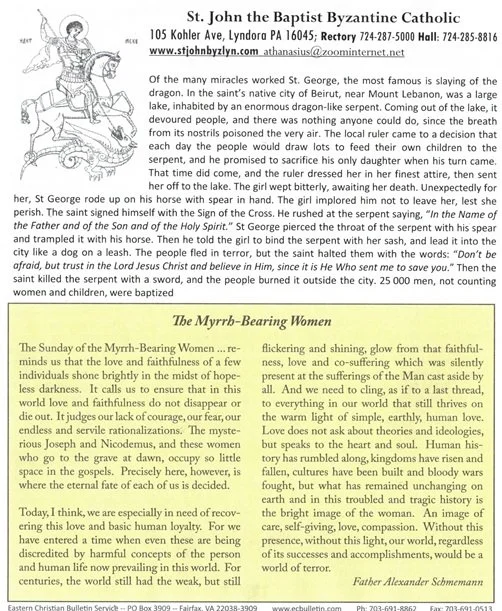
Sunday of the Myrrh-Bearing Women
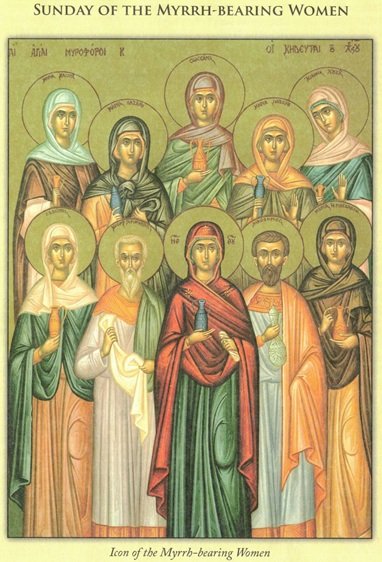
Christ is Risen! Indeed He is Risen!
Sunday of the Ointment Bearers
April 19, 2026
Sat 4/18/26 4:00pm Vigil Divine Liturgy +Martha Sapar by Family
Sun 4/19/26 9:30am Divine Liturgy +Don Suchy by Patty Nastasi
Wed 4/22/26 7:00pm Liturgy for Healing
Thu 4/23/26 9:30am Divine Liturgy of George Great-Martyr
Fri 4/24/26 7:00pm Resurrection Matins
Sat 4/25/26 4:00pm Vigil Divine Liturgy +Abbot Leo by Valerie Rodenbucher
Sun 4/26/26 9:30am Divine Liturgy +Peter and +Mary Kovchak by Drew Moniot
Variable Parts Sunday of the Ointment-Bearers Pgs 177 - 180
Epistle: Acts 6:1-7 Gospel: Mark 15:43-16:8
Memorial Candle Request: +Beverly Zavacky by Son Richard Pribus
Epistle Readers 18-April Mary Troyan 19-Apr Mike Dancisin 25-Apr John Baycura/Mary Motko 26-Apr Kathy Moyta
Please Pray for: Erik Bergh, Mike Oshlick, Kathy Moyta, Dorothy Moyta, Brian Buchlcovich, Lejen Warner, Sharon King, Ole J. Bergh, Liz Moyta, Fr. Michael Huszti, Fr. Laska, Susie Curcio, Teresa Milkovich, Robert Saper, Anna Habil, Mike Dancisin, Diane Sotak, Anna Pocchiari, Larry Hamil, Beverly Jones, Maryann Russin Schyvers, Nick Russin and Ken Konchan
Attendance: 4/11 — 17 4/12 — 74; Collection: 4/11 & 4/12 $1,797.00
Student Food Pantry: April's school donation will be a continuation from March of Mac N Cheese.
St. John BCC Historical Video & Presentation: On Saturday April 25th and Sunday April 26th a playing of some video footage done for our church's 75th anniversary will be shown after both day's liturgies. Drew Monoit and John Baycura will make very brief introductory comments and afterwards will be available to answer questions. On Saturday pizza will be provided. On Sunday the usual after-liturgy fare.
The Archeparchy is engaged in a time-sensitive review of the clearances. before Monday, April 20, 2026, please provide the names and contact information for each person affiliated with the parish by designation of their current role as: employee, ECF teacher, and/or volunteer to Fr. Radko.
Church Picnic: The Church Picnic will be held on Sunday. August 2nd at Connoquenessing Park.
9th Cathechesis: What is spiritual consolation? It is an experience of interior joy, that lets [us] see God's presence in all things. It strengthens faith and hope, and even the ability to do good. The person who experiences consolation never gives up in the face of difficulties because he or she always experiences a peace that is stronger than the trial. It is, therefore, a tremendous gift for spiritual life and for life in general... and to live this interior joy. Consolation is an interior movement that touches our depths. It is not flashy but soft, delicate, like a drop of water on a sponge (Spiritual Exercises, 335). The person feels enveloped in God's presence in a way that always respects his or her own freedom. It is never something out of tune that tries to force our will; neither is it a passing euphoria. On the contrary, as we have seen, even suffering — caused for example by our own sins — can become a reason for consolation. Let us think about Saint Augustine's experience, when he spoke with his mother Monica about the beauty of eternal life, or of Saint Francis' perfect joy, which moreover, was associated with very difficult situations he had to bear; and let us think of the many saints who were able to do great things not because they thought they were good or capable, but because they had been won over by the peaceful sweetness of God's love. It is the same peace that Saint Ignatius was amazed to discover in himself, when he read about the lives of saints. To be consoled is to be at peace with God, to feel that everything is settled in peace, everything is in harmony within us. This is the peace that Edith Stein felt after her conversion. A year after she received Baptism, she wrote — this is what Edith Stein says: "As I abandon myself to this feeling, little by little a new life begins to fill me and — without any pressure on my will — to drive me toward new realizations. This living inpouring seems to spring from an activity and a strength that is not mine and which, without doing me any violence, becomes active in me". Thus, genuine peace is one that makes good feelings blossom in us. Above all, consolation affects hope, and reaches out towards the future, puts us on a journey, allows us to take the initiatives that until then, had always been postponed or not even imagined, such as Baptism was for Edith Stein. Consolation is that type of peace, but not one in which we remain sitting there enjoying it, no.... It gives you peace and draws you toward the Lord and sets you off on a journey to do things, to do good things. In a moment of consolation, when we are consoled, we want to do so much good, always. Instead, when there is a moment of desolation, we feel like closing in on ourselves and doing nothing. Consolation spurs us forward in service to others, society, other people.
Spiritual consolation cannot be "piloted" — you cannot say "now may consolation come" — no, it cannot be "piloted". It cannot be programmed at will. It is a gift of the Holy Spirit. It allows a familiarity with God that seems to cancel distances. When Saint Therese of the Child Jesus visited the Basilica of the Holy Cross in Jerusalem in Rome at the age of 14, she tried to touch the nail venerated there, one of the nails with which Jesus was crucified. Therese understood her daring as a transport of love and confidence. Later, she wrote, "I truly was too audacious. But the Lord sees the depths of our hearts. He knows my intention was pure 1...] I acted with him as a child who believes everything is permissible and who considers the Father's treasures their own" (Autobiographical Manuscript, 183). Consolation is spontaneous and leads you to do everything spontaneously, as if we were children. Children are spontaneous, and consolation leads you to be spontaneous with a tenderness, with a very deep peace. A 14-year-old girl gives us a splendid description of spiritual consolation. We can feel a sense of tenderness towards God that makes us audacious in our desire to participate in his own life, to do what is pleasing to him because we feel familiar with him, we feel that his house is our house, we feel welcome, loved, restored. With this consolation, we do not give up in the face of difficulty — in fact, with the same boldness, Therese would ask the Pope for permission to enter Cannel even though she was too young, and her wish was granted. What does this mean? It means that consolation makes us daring. When we find ourselves in a moment of darkness, of desolation, and we think: "I am not capable of doing this". Desolation brings you down. It makes you see everything as dark... Instead, in times of consolation, you see the same things in a different way and say: "No, I am going ahead. I will do it". "But are you sure?" "I feel God's strength and I am going ahead". And so, consolation spurs you to go ahead and to do those things that you would not be capable of doing in a moment of desolation. It spurs you to take the first step. This is the beauty of consolation.
But let us be careful. We have to distinguish well between the consolation that comes from God and false consolations. Something similar happens in spiritual life that also happens in human productions: there are originals and there are imitations. If authentic consolation is like a drop on a sponge — it is soft and intimate — its imitations are noisier and flashier. They are pure enthusiasm, like straw fires, lacking substance, leading us to close in on ourselves and not to take care of others. In the end, false consolation leaves us empty, far from the centre of our existence. This is why, when we feel happy, at peace, we are capable of doing anything. But let us not confuse this peace with passing enthusiasm because there is enthusiasm today, but then it wanes and is no more. This is why we have to discern even when we feel consoled because false consolation can become a danger if we seek it obsessively as an end in itself, forgetting the Lord. As Saint Bernard would say, we seek the consolation of God rather than the God of consolations. We have to seek the Lord, and the Lord consoles us with his presence. He makes us move forward. And we should not seek God because he brings us consolations, with that as an underlying motive. No, this is not right. We should not be interested in this. This is the dynamic of the child, who looks for his or her parents only to get something, but not for their sake; out of their own interests. They go by interest — children know how to do this, they know how to play, and when the family is divided, and they are accustomed to going to one and going to the other, this is not good, this is not consolation, but personal interest. We too run the risk of living our relationship with God in a childish way, seeking our own interests, trying to reduce God to an object that we use and consume, losing the most beautiful gift which is God Himself.